A Day Plan Around A Tandem Skydive At Tauranga Airport
A tandem jump at Tauranga Airport takes 1.5 to 2 hours door to door, and the operator asks you there 30 minutes early. That leaves most of a day to plan around, whether you are staying in Mount Maunganui or off a cruise ship at Salisbury Wharf.
Short answer
Plan the jump block first: arrive 30 minutes early at Tauranga Airport, Mount Maunganui, and allow 1.5 to 2 hours for the whole experience. The climb to altitude takes 15 to 20 minutes, freefall runs up to about a minute from 15,000 ft, and you land back at the same spot. Everything else in the day fits around that fixed block.
A tandem skydive compresses into a 1.5 to 2 hour block, which makes it an easy anchor for a whole day out: fix the jump window, then build the rest of the schedule around it. This page walks through the day in order, from the night before to the drive home, using the operator's own timing figures and the drive times into Mount Maunganui. If you are still choosing a jump, the how to book a Tauranga tandem skydive guide walks through holding a slot first.
| Fact | Detail |
|---|---|
| Arrival buffer | At least 30 minutes before your scheduled takeoff |
| Whole experience | 1.5 to 2 hours on site |
| Climb to altitude | 15 to 20 minutes in a Cessna 182 carrying two tandems |
| Freefall | 40 seconds at 12,000 ft, about 1 minute at 15,000 ft, indication only |
| Canopy ride | 3 to 5 minutes |
| Takeoff and landing | Both at Tauranga Airport, Mount Maunganui |
| Weight to jump | Minimum 30 kg, book freely under 110 kg, phone the operator above that |
| Minimum age | 7, with a parent or guardian consent letter under 18 |
How Does A Skydive Day At Tauranga Airport Actually Run?
The day runs on a fixed sequence: check in, gear up, a 15 to 20 minute climb in a Cessna 182 carrying two tandems, up to about a minute of freefall from 15,000 ft, a 3 to 5 minute canopy ride, then a landing back on the airport apron you took off from. The operator asks every jumper to arrive at least 30 minutes before takeoff, and the whole experience sits inside 1.5 to 2 hours.
The jump itself starts with paperwork and harness fitting. The operator's waiver asks you to declare conditions such as severe motion sickness, asthma, allergies, heart conditions, epilepsy or sinus congestion, and it reserves the operator's right to withdraw anyone whose safety they are concerned about. That check-in period is one reason the 30 minute early arrival matters: a harness that fits badly is not something to discover at altitude, and children under 12 are asked to visit the dropzone first so staff can fit the harness before the day.
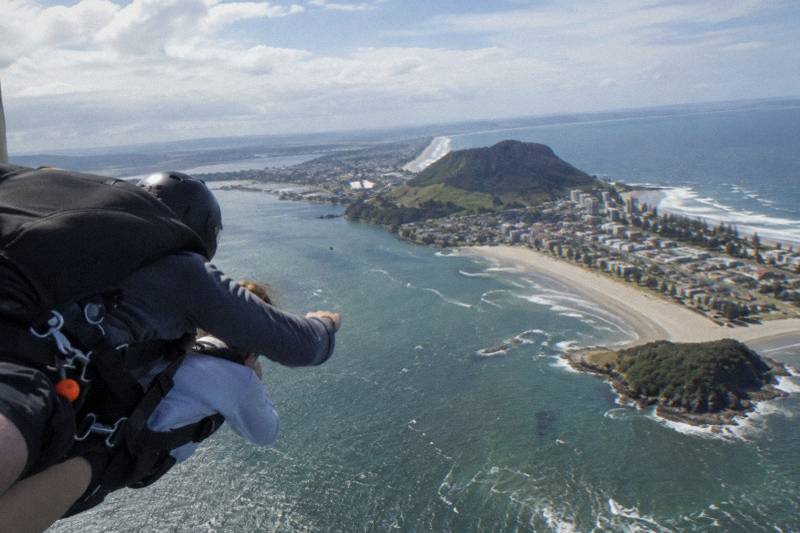
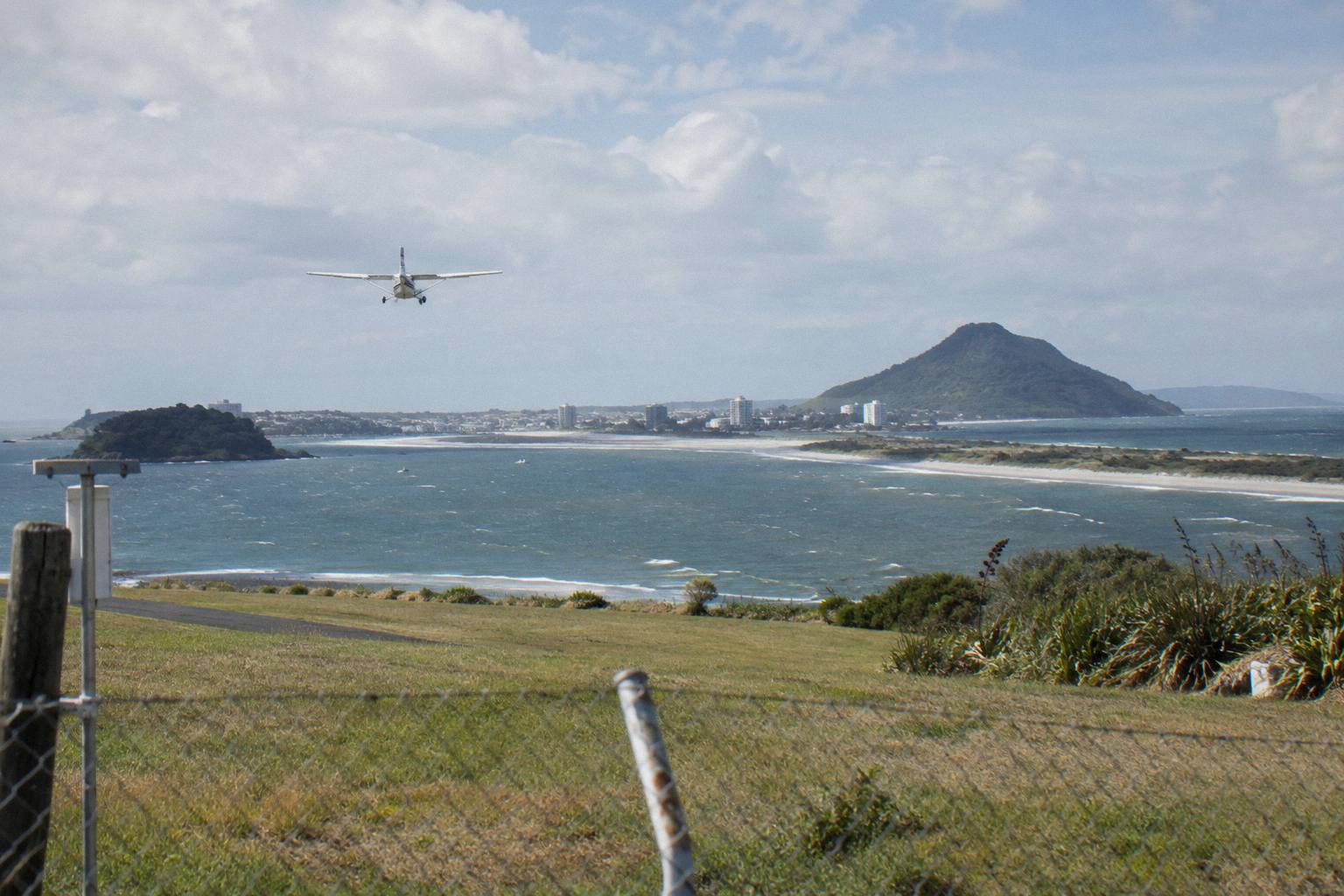
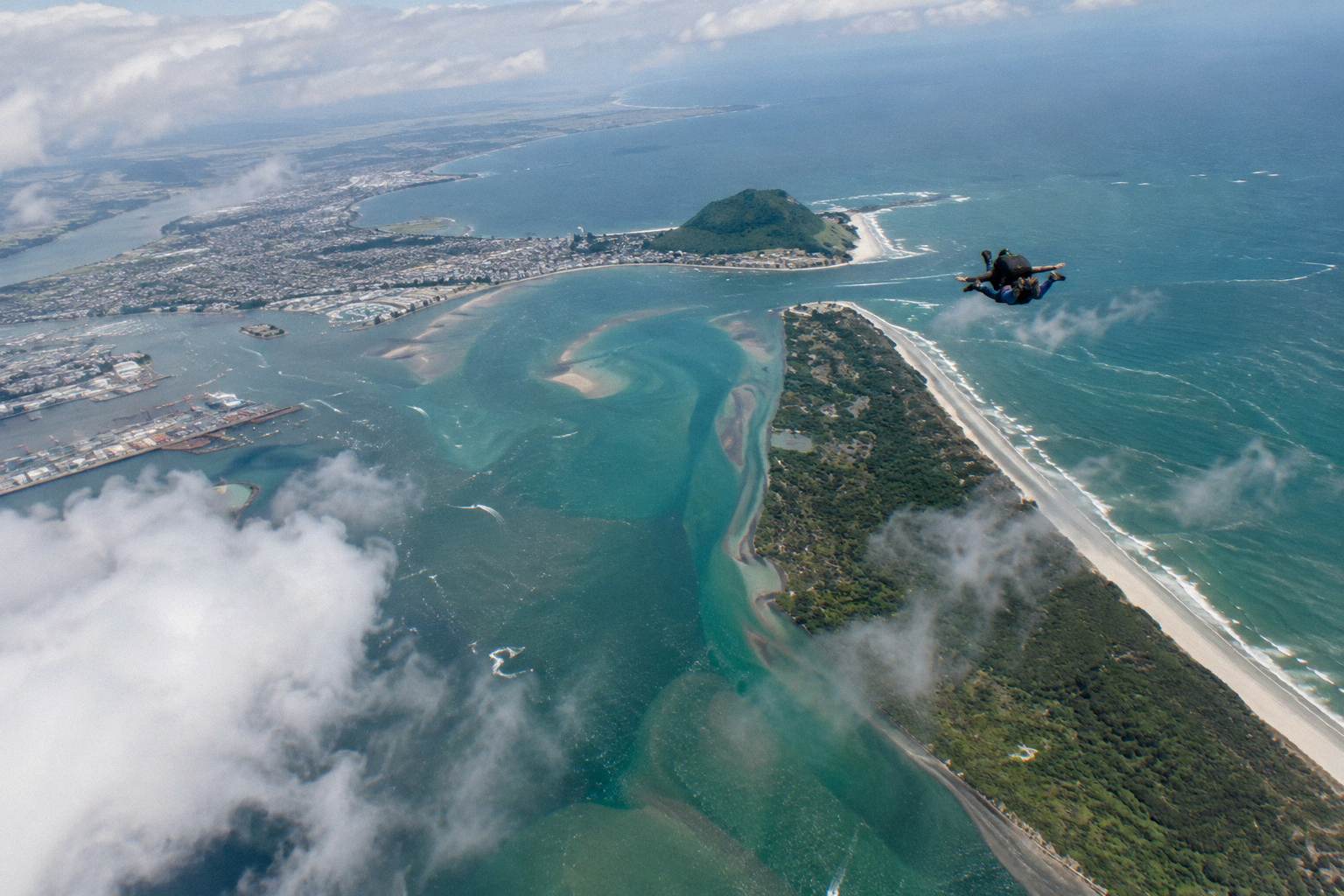
Once the aircraft is loaded, the flight up is part of the product, not dead time. The operator describes the climb as a scenic flight in itself, 15 minutes to 12,000 ft or 20 minutes to 15,000 ft, with the harbour, Matakana Island's 20 kilometre length and the coast in the windows. Because the Cessna 182 takes two tandems at a time, a pair travelling together can plan to be on the same load, and spectators have a viewing area at the same spot the aircraft takes off from and lands at.
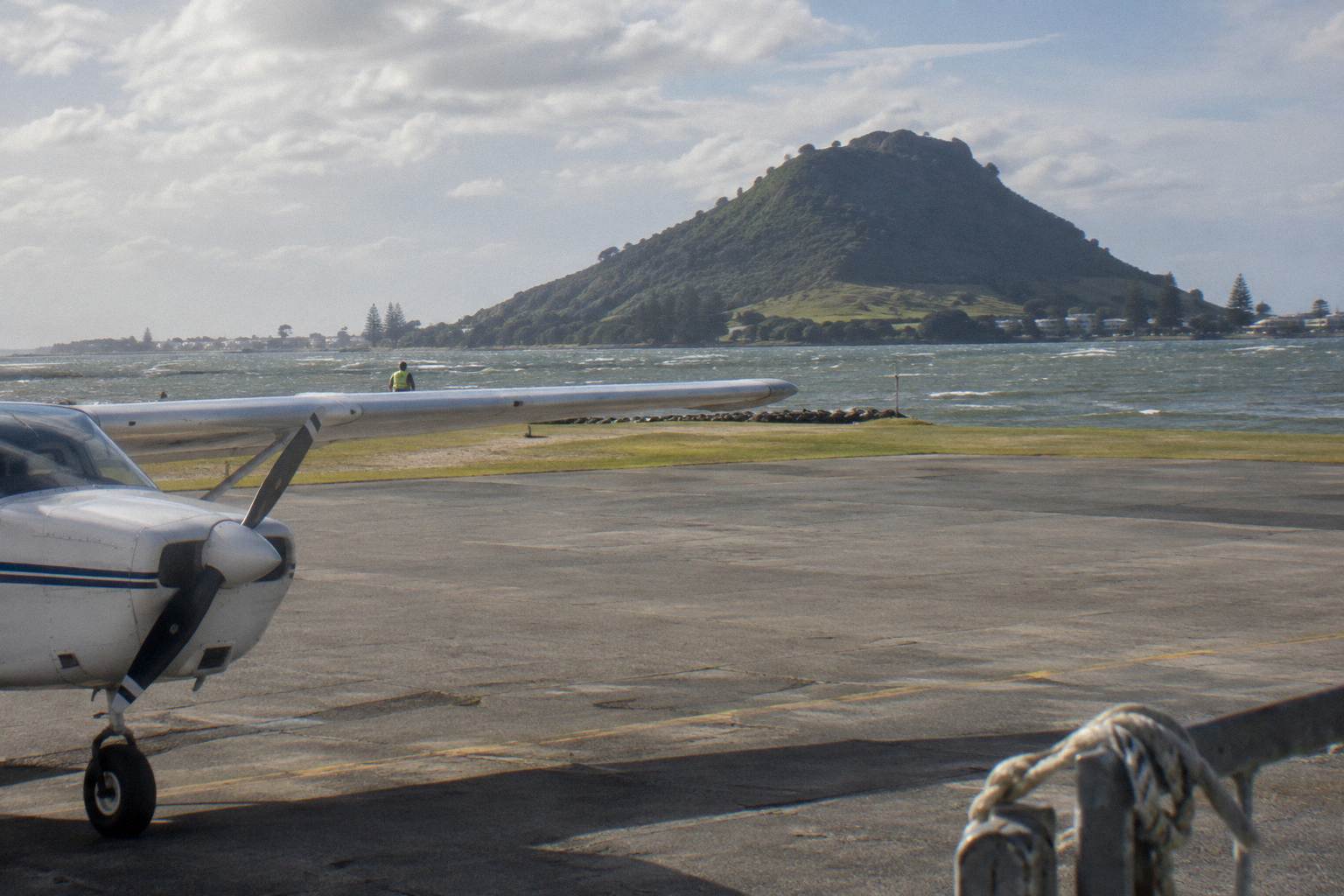
The landing matters for planning more than people expect. You land back at Tauranga Airport, not on the beach; Mount Maunganui's beach is a view from above, not a touchdown zone. The operator notes the landing area is small and governed by airport rules, which is why the jump runs from an airport at all. Once you are down and the harness is off, the jump block is over, and the operator says camera packages arrive by email as a Dropbox link by the end of the day at the latest, so you do not need to budget waiting time for footage.
One structural point that shapes the whole itinerary: the aircraft, the drop zone and the landing area are all the same place. There is no transfer leg between check-in, takeoff and landing. A day plan built around a jump here has exactly one fixed location to get to and from, which is what makes the 1.5 to 2 hour block so predictable.
What Time Should You Arrive And How Long Does Everything Take?
Budget 30 minutes for arrival plus 1.5 to 2 hours for the experience itself, so a morning jump slot consumes roughly the first half of a day. Freefall is 40 seconds from 12,000 ft or about a minute from 15,000 ft, indication only. If you book direct, the booking form's default first jump of the morning is 10am and the first of the afternoon is 12pm when no other booking exists.
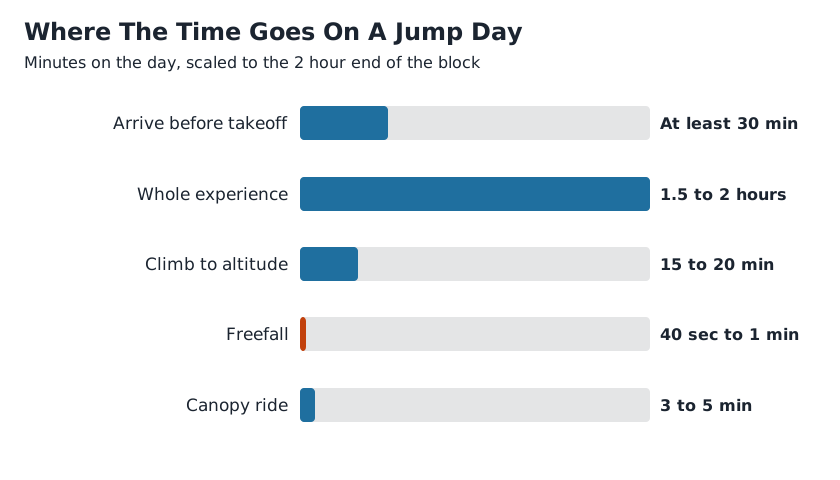
The timing numbers come straight from the operator's what-to-know page: arrive at least 30 minutes before takeoff, allow around 1.5 hours for the whole experience on a quiet day, and the FAQ rounds that to between 1.5 and 2 hours. Build your day on the 2 hour end of that range. Weather and airport traffic can add delay, and the operator says jumps can run a little late for exactly those reasons.
Two figures are worth separating, because they answer different planning questions. The 1.5 to 2 hours is time on site. The 15 to 20 minutes is the climb to altitude, which is airborne time inside that block. If you are telling a non-jumping companion when to expect you back in the car park, quote the on-site figure, not the airborne one.
| Stage | Time | Notes |
|---|---|---|
| Arrival buffer | 30 minutes | Before scheduled takeoff, for check-in and harness fitting |
| Climb to 12,000 ft | 15 minutes | Scenic flight in the Cessna 182 |
| Climb to 15,000 ft | 20 minutes | Same aircraft, longer climb |
| Freefall at 12,000 ft | Up to 40 seconds | Indication only |
| Freefall at 15,000 ft | About 1 minute | Indication only |
| Canopy ride | 3 to 5 minutes | Operator pages give 3 to 4, 4 to 5, and 5 minutes |
| Total on site | 1.5 to 2 hours | Longer on busy days |
If height choice is still open, the 12,000 versus 15,000 ft comparison works through the trade-off in detail. For day planning the short version is that the higher jump adds roughly 5 minutes of climb and about 20 seconds of freefall, so the two options barely move the total block.
Prices, for the arithmetic on the day: the operator's own direct booking shows NZ$449 for 12,000 ft and NZ$549 for 15,000 ft, amounts in New Zealand dollars, with camera packages from NZ$149 to NZ$349 as paid extras. Prices vary by date and group, and the booking page shows the price for your date. Whether the jump price is worth it is a separate question, and the is skydiving worth the money discussion on the blog covers the value angle.
How Do You Build The Morning Around The Jump?
Treat the jump as the first fixed appointment of the day and schedule everything else after it, not before it. Arrive at the airport 30 minutes early, expect to be finished within 2 hours of your slot, and only then commit to anything with its own start time. A morning jump typically leaves the afternoon clear; an afternoon jump leaves the morning free but compresses everything after, because the block can run long.
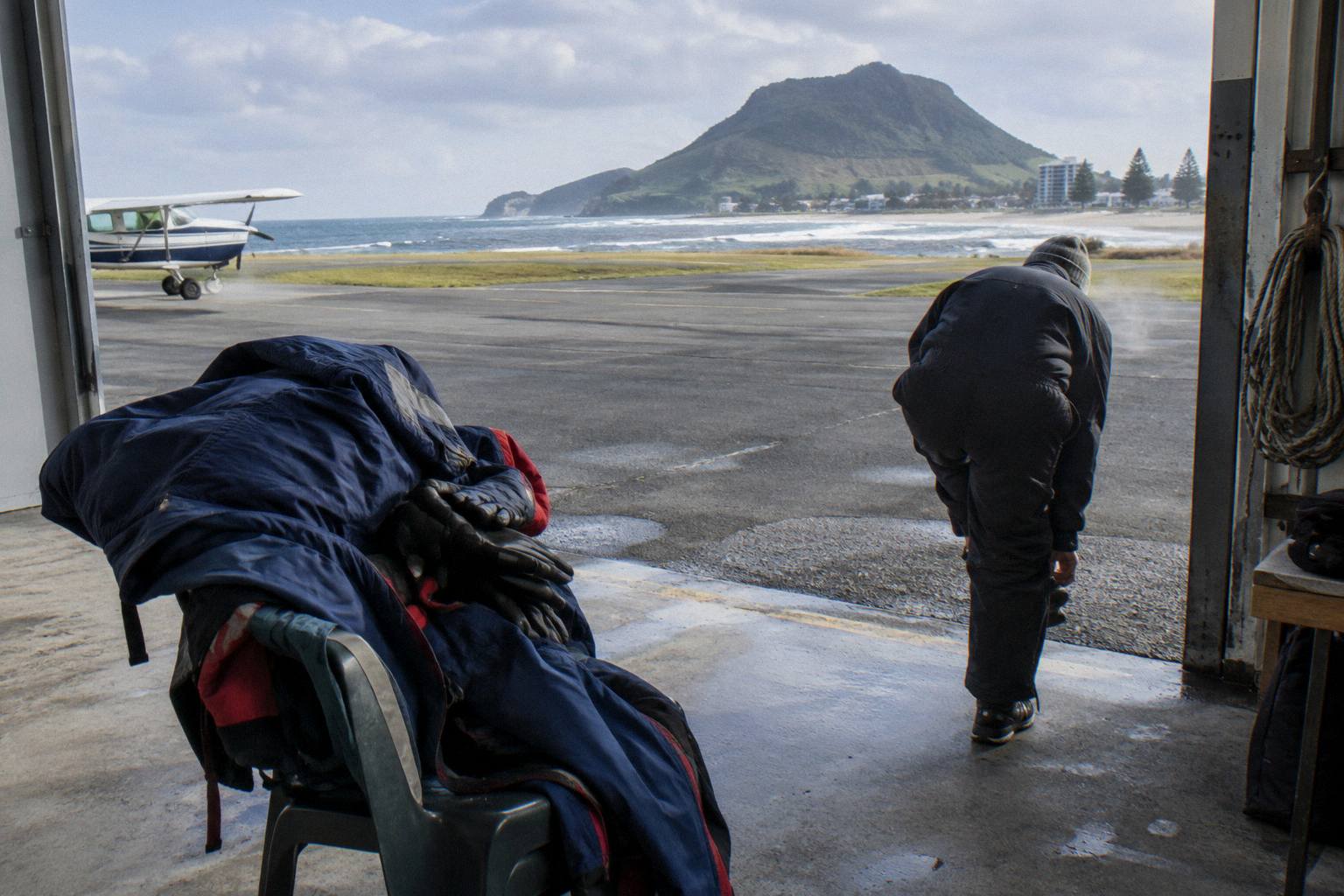
The practical reason to front-load the jump is weather. The operator phones on the day if conditions look poor and works something out with your schedule, which means an early slot gives you the most room to rebook within the same day. A late-afternoon jump that gets weather-held has nowhere to move. That is also the argument for not booking a tightly timed activity, a ferry or a tour departure, immediately after a jump: leave a buffer of at least an hour beyond the 2 hour worst case.
The trio of jump listings below covers the same airport, the same aircraft and the same 1.5 to 2 hour block; the differences are the altitude options and the way each listing packages the experience. Checking a live date on any of them is the single scheduling decision that locks the rest of the day in place.
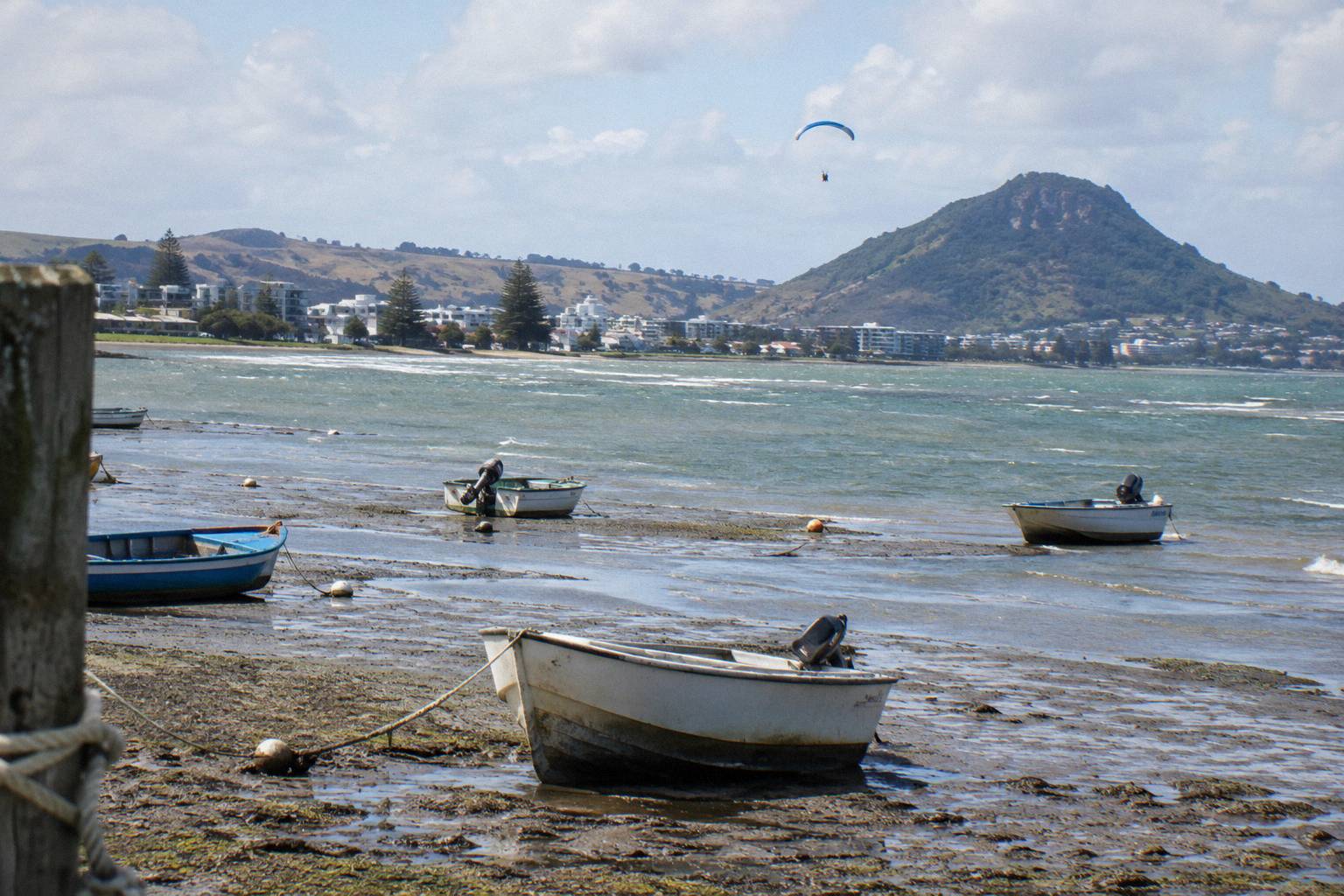
The From Tauranga: Skydive over Mount Maunganui listing is the natural anchor for a planner: it offers 12,000 or 15,000 ft as options on one booking, includes a 20 to 25 minute scenic flight window, and carries a 5.0 rating from 66 reviews. Its duration is listed at 1.5 hours, sitting at the brisk end of the operator's 1.5 to 2 hour range. If the day has more than one person jumping, note the listing caps a booking at two travellers per slot, which matches the two-tandem aircraft.
For anyone still deciding what surrounds the jump, the sequencing principle is simple: jump block fixed first, meals and walks fitted after. The operator asks that you eat normally rather than skip food, and the eating before a Tauranga skydive guide covers the pre-jump meal logic: a light meal one to two hours before works better than an empty stomach.
What If You Are Jumping On A Cruise Stop?
Cruise passengers have the tightest version of this planning problem, and the numbers work in your favour: Tauranga Airport sits roughly 5 to 6 km from the cruise terminal at Salisbury Wharf, a 5 to 10 minute drive, and the jump block is 1.5 to 2 hours. Book the earliest slot you can, plan to be back at the ship 3 hours after takeoff at the latest, and leave the afternoon for the port area.
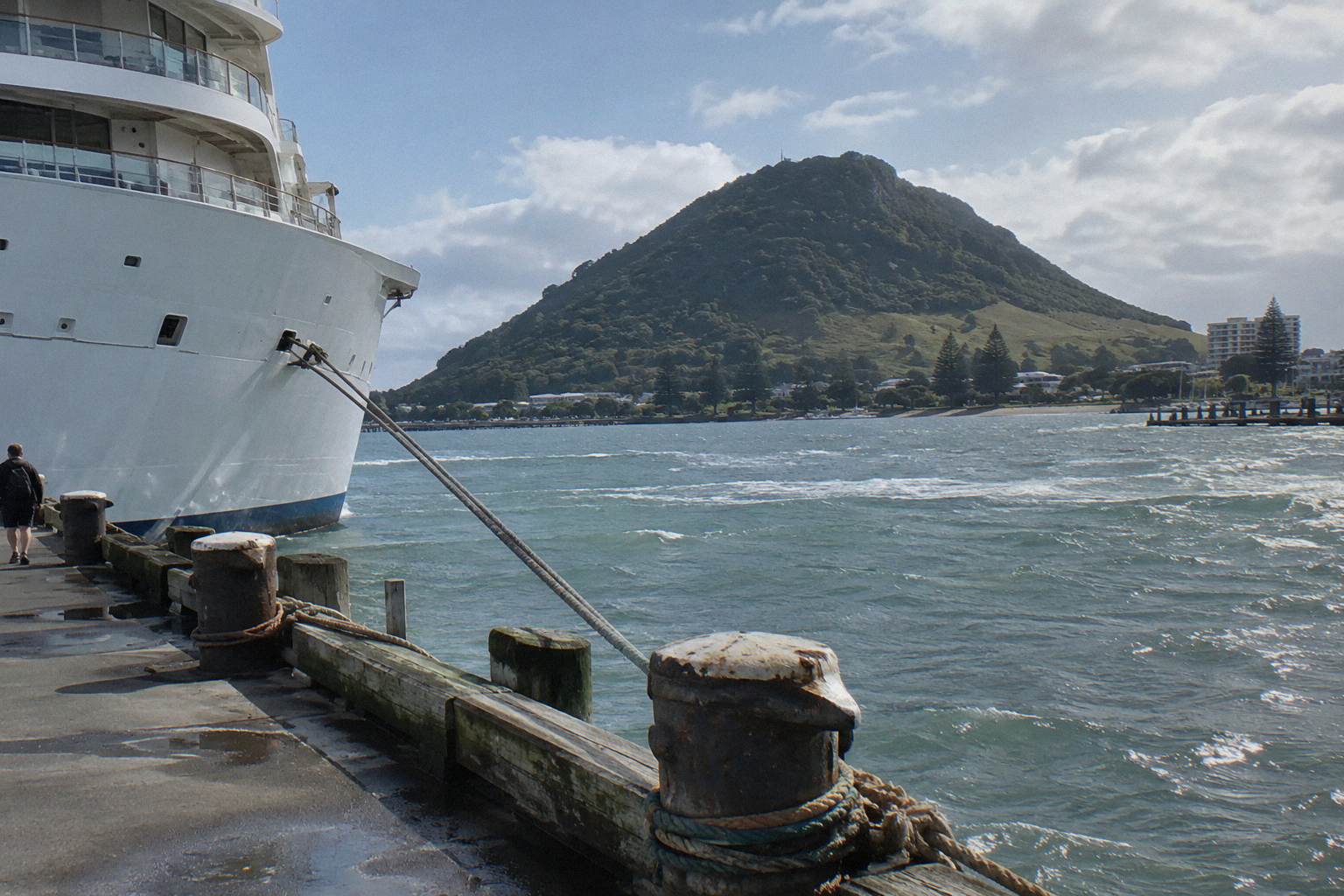
The operator's own FAQ gives the drive figure: the airport is 5 to 10 minutes from where the cruise ship docks. The 2026 to 2027 Tauranga cruise season runs October to April with 79 ship calls expected, so morning skydive slots compete with every other shore excursion passenger's morning. The earliest-slot advice matters doubly here, both for weather rebooking room and for the walk-back-onboard deadline every cruiser carries.
The risk to manage is the jump running long. Airport traffic and weather can delay a load, and the operator says so plainly. A 10am takeoff with a 2 hour block plus transfer still returns you to the wharf by early afternoon; a 2pm takeoff with a delay starts eating into all-aboard time. The dedicated skydiving on a Tauranga cruise stop guide works the full timeline, including what to do if the weather call goes against you.
One more cruise-specific point: free cancellation up to 24 hours before the start applies on the booking page, which pairs well with a port call, since a missed tender or a changed itinerary is exactly the kind of event you want cover for. Ask the operator about same-day weather rebooking when you check in; they handle weather by phone on the day.
Should You Add A Scenic Flight To The Day?
Yes, if the day has room for a second aviation block, because several scenic options depart from the same airport area and run to fixed durations: a 30-minute fixed-wing loop around Mauao and the coast, longer fixed-wing flights toward the Coromandel and Cathedral Cove or Mount Ruapehu, a Cathedral Cove helicopter tour, and a Taupo helicopter and skydive combo. Separate them from the jump by a meal or a walk, and let non-jumpers take a scenic flight while you jump, using the same waiting window twice.
The scenic roster from the same airport gives you fixed durations to schedule against. Fixed-wing options include a 30-minute Mount Maunganui flight, a 1.5-hour Coromandel and Cathedral Cove flight, and a 2-hour flight toward Mount Ruapehu that climbs to 10,000 ft. Helicopter time comes on the longer routes: a Cathedral Cove coastal tour of 2.5 hours with about 1.5 hours flying, plus a Taupo helicopter flight paired with a 15,000 ft skydive.
| Scenic option | Duration | Operator | Good fit in the day plan |
|---|---|---|---|
| Mount Maunganui fixed-wing flight | 30 minutes | Skydive Tauranga's scenic arm | Afternoon slot after an early jump |
| Coromandel and Cathedral Cove flight | 1.5 hours | Skydive Tauranga's scenic arm | A full half-day commitment |
| Ruapehu scenic flight | 2 hours, climbing to 10,000 ft | Skydive Tauranga's scenic arm | Only on a dedicated aviation day |
| Mount Maunganui scenic flight | 30 minutes | Skydive Tauranga | Squeezes into the gap a jump leaves |
For a group where some jump and some do not, the pairing works neatly: the jumpers' 1.5 to 2 hour block is exactly the window a non-jumper can fill with a 30-minute flight plus waiting time at the same airport precinct. The skydive versus scenic flight comparison and the helicopter-versus-skydive breakdown cover which experience suits which traveller, which is worth settling before the day rather than on the apron.
For anyone whose day trip extends as far as Taupo, the Lake Taupo 12,000ft skydive listing is a different beast entirely: it runs from Wharewaka in Taupo, about 143 km and roughly 1 hour 50 minutes to 2 hours of driving from Tauranga, so it is a full-day itinerary rather than an add-on. It carries a 5.0 rating from 457 reviews and includes transport in its listing. That is a day plan built around the drive, not around a 2 hour airport block.
If the day plan is staying local, the shortest scenic add-on is the 30-minute Mount Maunganui Scenic Flight, a fixed-wing circuit around Mauao and the Bay of Plenty beaches run by Skydive Tauranga from the airport. The only Tauranga helicopter product is the Cathedral Cove coastal tour, which runs 2.5 hours with about 1.5 hours flying. The getting to Tauranga Airport guide covers the drive times from Auckland, Hamilton and Rotorua for anyone arriving from outside the region.
What Should You Sort The Day Before?
Three things: the booking itself with a date and slot held, the logistics of getting to Tauranga Airport with the drive time from your base, and the small personal checklist. Closed shoes are mandatory, comfortable weather-appropriate clothing is the rule, the operator supplies jumpsuit, hat and goggles that fit over glasses, and you should eat a normal light meal rather than arrive either full or empty. Alcohol is off the table beforehand.
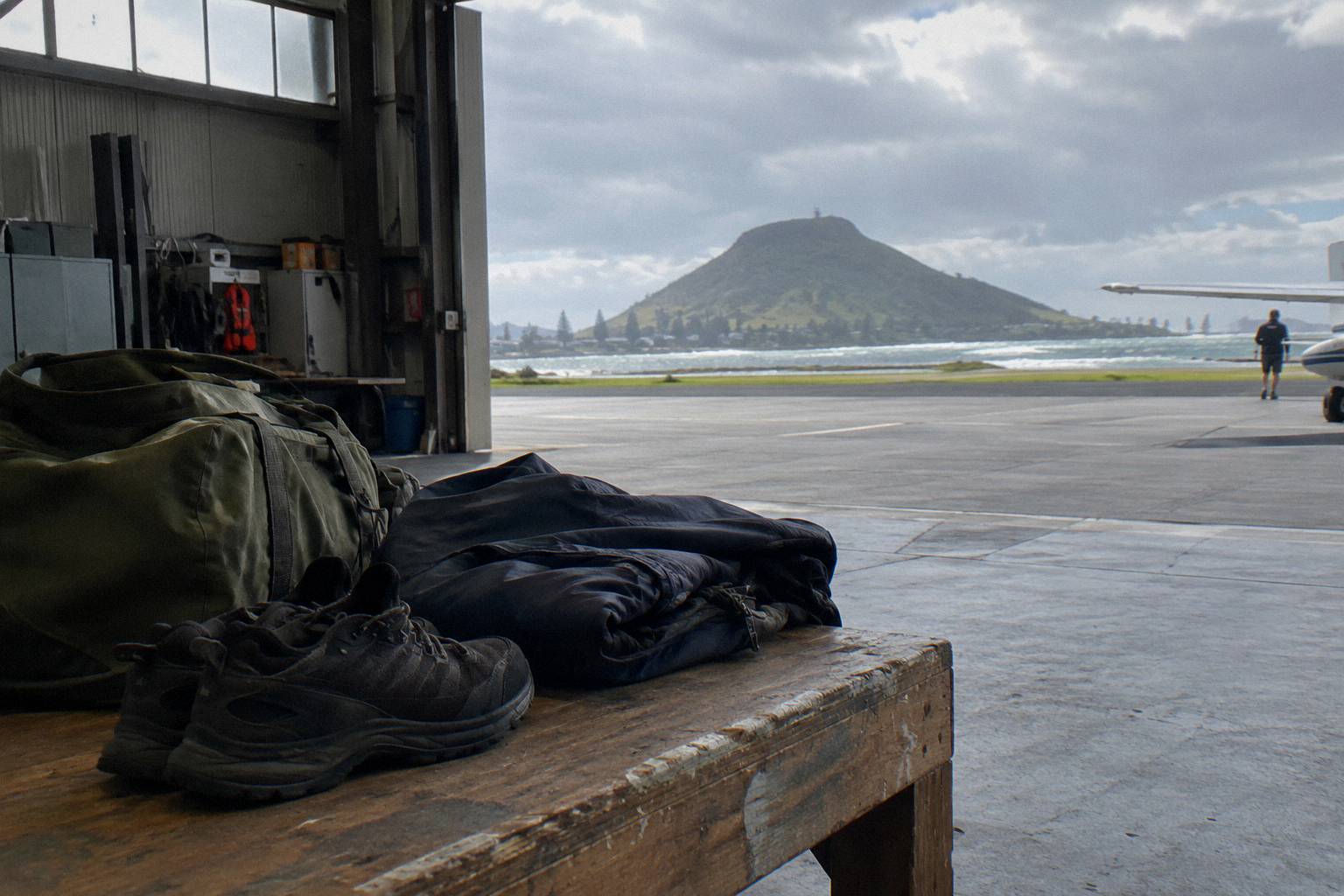
Drive times for the night before, all sourced: Auckland to Tauranga is 204 km and about 2 hours 30 to 40 minutes; Hamilton to Tauranga is about 105 km and 1 hour 25 minutes; Rotorua to Tauranga is about 57 km and 50 minutes; Taupo to Tauranga is about 143 km and 1 hour 50 minutes to 2 hours. Anyone driving in on the morning itself should add the 30 minute arrival buffer to those figures, and in winter remember that an early start means an early drive.
The personal checklist is short because the operator supplies the technical gear. What to wear: comfortable clothes, closed shoes that cannot fall off, gloves in winter; a jumpsuit is optional in warm weather. Glasses are fine, since the supplied goggles fit over frames. What to eat: a normal light meal one to two hours before the jump, water through the morning, and go easy on caffeine if you are not a regular drinker of it. The what to wear for a Mount Maunganui skydive guide carries the full clothing checklist.
| The night before | Why it matters |
|---|---|
| Confirm the jump slot and date | The booking calendar sets the day's fixed point |
| Plan the drive using your real distance | 50 minutes from Rotorua, 2.5 hours from Auckland |
| Set out closed shoes and layered clothes | Closed footwear is mandatory; jumpsuit optional in warmth |
| Decide on a camera package | The outside camera flyer package must be prebooked |
| Book any scenic flight separately | Two aviation blocks need slack between them |
| Check the weather picture | The operator phones on the day and works around it |
One decision that genuinely has to happen the day before is the outside camera flyer package. At NZ$349 it is the premium filming option, with another skydiver jumping alongside you with a helmet camera, and the operator states it needs to be prebooked. The wrist-camera and 360 packages at NZ$149 to NZ$229 are simpler add-ons; the photo and video packages guide compares all of them. Passengers cannot carry their own phone or camera on the jump under New Zealand civil aviation rules.
If the jump day doubles as a wider trip, the where to stay for a Tauranga skydive guide covers bases near the airport, and Mount Maunganui itself, the 232 metre volcanic cone the harbour wraps around, anchors the walk that fills most post-jump afternoons; the Wikipedia page on the mountain covers its geography. Tauranga Airport sits in the Mount Maunganui suburb adjacent to the harbour, about 3 km northeast of the city centre, per the airport's Wikipedia entry, which also notes Air New Zealand's direct flights to Auckland, Wellington and Christchurch.
What Trips People Up Before You Book
The recurring mistakes are scheduling ones: booking something tightly timed straight after the jump, cutting the arrival buffer, assuming a beach landing, and forgetting that weather, not the calendar, decides whether a load flies. People also assume the day is consumed by the jump itself, when the block is only 1.5 to 2 hours, and arrive having skipped breakfast. Each of these is avoidable with one scheduling decision made in advance.
The tight-follow-on mistake is the most common. The block can run to 2 hours, the operator says loads can run a little late with weather or airport traffic, and the landing is at the airport, so add transfer time before whatever comes next. Give yourself an hour of slack beyond the worst case before any fixed-start commitment.
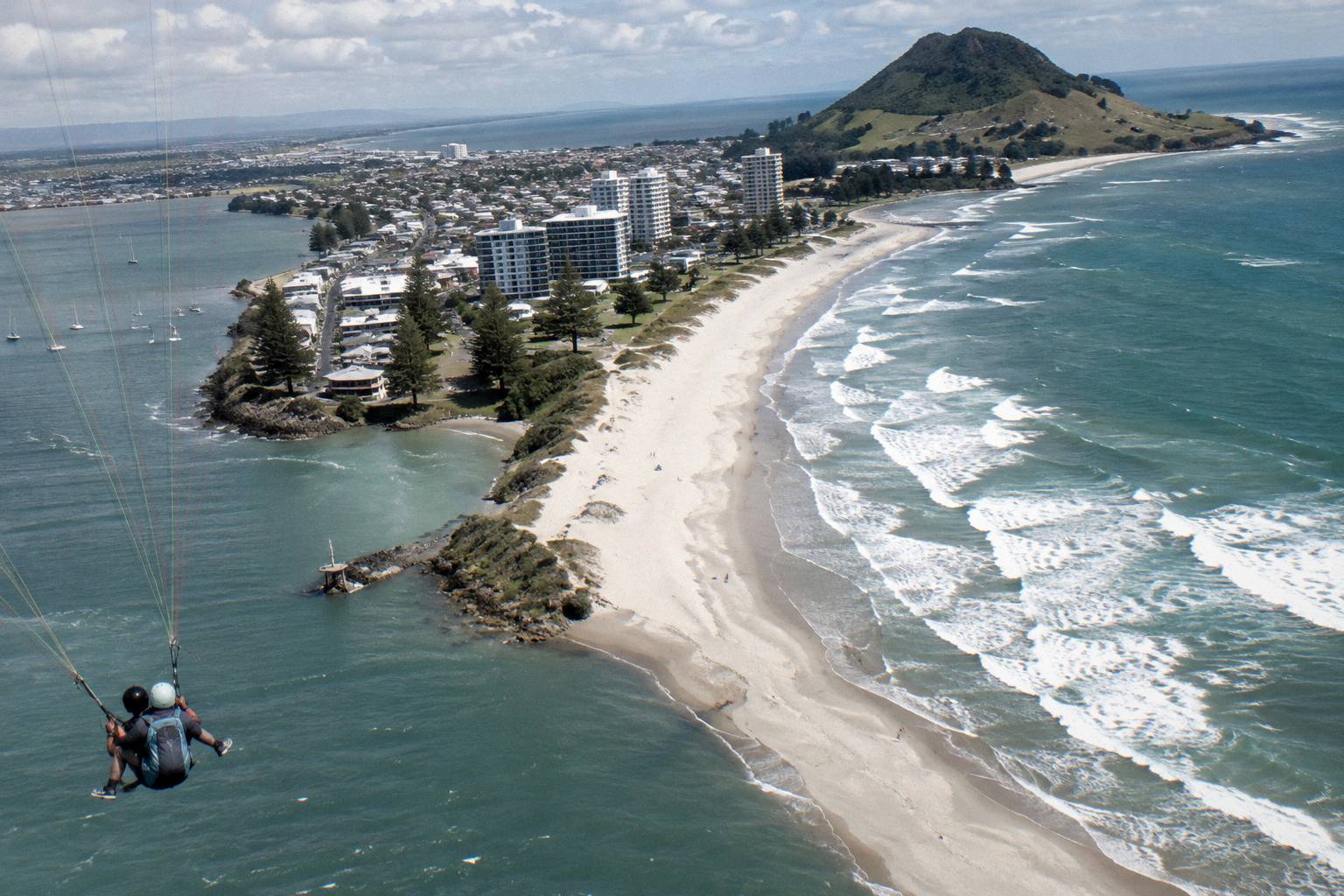
The beach assumption is the second. The jump lands at Tauranga Airport; the beach and Mauao's 232 metre dome are the view from 12,000 or 15,000 ft, not the landing zone. Anyone planning a "land on the sand" photo moment is planning for something that does not exist here.
The weather mistake deserves a plain statement: tandem skydiving carries real risk, and conditions, wind, cloud and rain, are what ground loads. The operator's process is a phone call on the day and an arrangement that fits your schedule. Skydiving in New Zealand operates under Civil Aviation Rules Part 115 and Part 105; the Civil Aviation Authority Part 115 rule requires adventure aviation operators, including tandem parachute operations, to hold an operator certificate, and tandem masters must open the main parachute at not less than 5,000 ft under Part 105. Schedule with that respect for weather and the day plans itself.
Common Questions About Planning A Jump Day
How Long Should I Set Aside For A Skydive Day?
Set aside 2.5 hours from arrival to walking out: the 30 minute early arrival plus the 1.5 to 2 hour experience block. Build the rest of the day after that, leaving slack before any fixed-start activity in case the load runs late with weather or airport traffic.
What Time Should I Arrive For My Jump?
At least 30 minutes before your scheduled takeoff, per the operator's own guidance. That window covers check-in, the waiver and harness fitting. If you book direct, the booking form's defaults are a 10am first morning jump and a 12pm first afternoon jump when no booking exists, with earlier or later slots assigned by availability.
Can I Do A Skydive On A Cruise Stop?
Yes, and the distances cooperate: the airport is about 5 to 6 km from the cruise terminal, a 5 to 10 minute drive. Take the earliest slot available, expect to be back at the wharf within about 3 hours of your takeoff time, and use the free cancellation up to 24 hours before start as cover for a changed itinerary.
Should I Eat Before A Tandem Skydive?
Yes, a normal light meal one to two hours before. An empty stomach makes lightheadedness more likely, and a heavy meal is no better. Drink water through the morning, keep caffeine to your usual level, and no alcohol in the hours before the jump.
Can Non-Jumpers Watch Or Do Something At The Airport?
There is a spectators' viewing area at the same spot the aircraft takes off from and lands. The same airport precinct also runs scenic flights from 30 minutes upward, which fills the jumpers' 1.5 to 2 hour block neatly for anyone not jumping.
What Happens If The Weather Cancels My Jump?
The operator phones you on the day and works out an arrangement that fits your schedule, which may mean rebooking. The booking page carries free cancellation up to 24 hours before the start for a full refund; weather-day handling itself is arranged by phone, so ask about it when you book if your dates are fixed.
Whichever day you pick, the pieces stay the same: one airport, one 1.5 to 2 hour block, and a harbour town that fills the hours either side. Tauranga Skydive is the site that holds the whole picture, from booking a Tauranga tandem skydive to the morning-of checklist. If you already know your dates, see the live calendar on the From Tauranga: Skydive over Mount Maunganui page, or check availability before the itinerary firms up.