Skydive From Tauranga Airport: Meeting Point, Arrival Time And Where You Land
The drop zone sits inside Tauranga Airport on the Mount Maunganui side of the harbour, the same grass you land back on, and everything about the day, from the 30-minute early arrival to the spectator viewing area, follows from that single fact.
Short answer
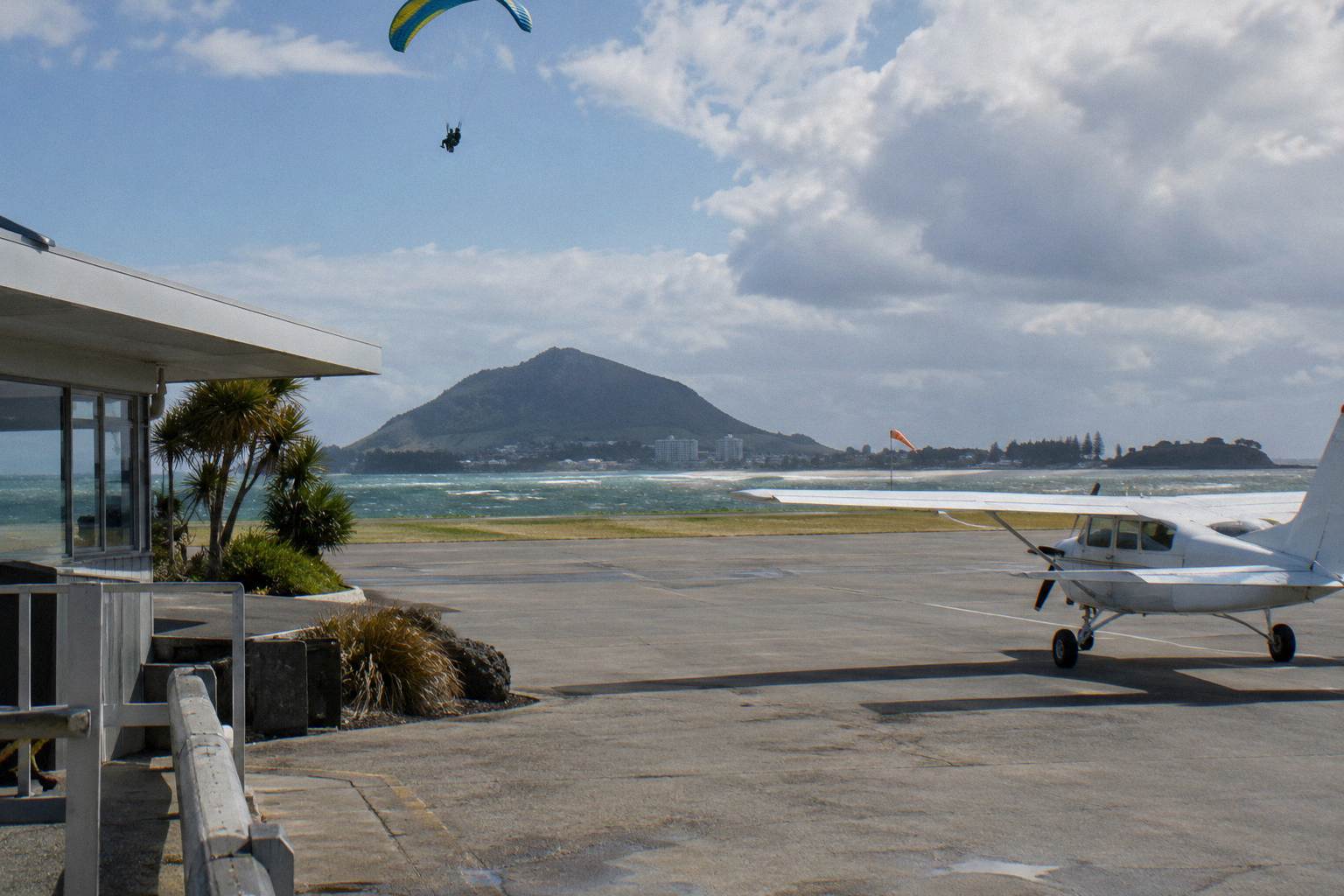
Meet at Tauranga Airport, Mount Maunganui, where the operator's hangar sits among the airport buildings on the Mount side of the harbour. Arrive at least 30 minutes before your booked takeoff, allow 1.5 to 2 hours on site, and expect to take off and land on the same airfield, about 5 to 10 minutes' drive from the cruise ship dock.
For the full picture of what you are actually booking, the tandem skydive listings that fly from this airfield cover the jump options departing Tauranga Airport, and the roster is worth a skim before the logistics.
| Fact | Detail |
|---|---|
| Meeting point | Tauranga Airport, Mount Maunganui |
| Registered address | 2 Dakota Way, Mount Maunganui 3116 |
| Arrival buffer | At least 30 minutes before scheduled takeoff |
| Total time on site | Between 1.5 and 2 hours |
| Takeoff and landing | Same place, on the airport airfield |
| Aircraft | Cessna 182 carrying two tandems at a time |
| Cruise terminal distance | 5 to 10 minutes by car |
| Distance from Tauranga CBD | About 3 km northeast |
Where Exactly Is The Meeting Point At Tauranga Airport?
The meeting point is the operator's base at Tauranga Airport, Mount Maunganui, and the registered company address behind it is 2 Dakota Way, Mount Maunganui 3116. The airport sits in the Mount Maunganui suburb beside Tauranga Harbour, roughly 3 km northeast of the Tauranga city centre. You are not meeting at a beach, a shopfront in town, or a separate drop zone: the office, the aircraft and the landing area are all inside the same airport footprint.
That single location answers most of the practical questions people have before booking. The airport is a small regional field that also handles scheduled Air New Zealand flights to Auckland, Wellington and Christchurch, as described on the Wikipedia page for Tauranga Airport. The skydive operation works out of a hangar among the other aviation businesses on the field, and the aircraft, a Cessna 182 that takes two tandems at a time, climbs from the same runway the scheduled services use.
The name of the suburb matters more than you might expect. Mount Maunganui and Tauranga sit on opposite sides of the harbour entrance, and the airport is on the Mount side. If your accommodation is in central Tauranga, you will cross the harbour bridge and reach the field in a few minutes; if you are on the Mount, you are practically next door. Either way, the address to type into a phone is Tauranga Airport, Mount Maunganui, and the company register records the base as 2 Dakota Way, Mount Maunganui 3116.
One point that catches people out: the operator's own booking form has at times printed a slightly different street name for the same airport precinct, so treat "Tauranga Airport, Mount Maunganui" as the reliable instruction and the street address as background detail. The field is small enough that once you are inside the airport grounds, finding the aviation hangars is not a hunt. If you want the deeper background on the sequence of events once you have checked in, read what actually happens on a Bay of Plenty tandem skydive, which walks through gear-up, the climb and the jump itself.
When Should You Arrive, And How Long Does The Visit Take?
Arrive at least 30 minutes before your scheduled takeoff, and plan for the whole visit to run between 1.5 and 2 hours from check-in to landing, as the operator states on its FAQ and what-to-know pages. The buffer is not padding: you need to check in, meet your instructor, be fitted into a harness, receive a safety briefing and board the aircraft, and on a quiet day things can move faster than the upper estimate.
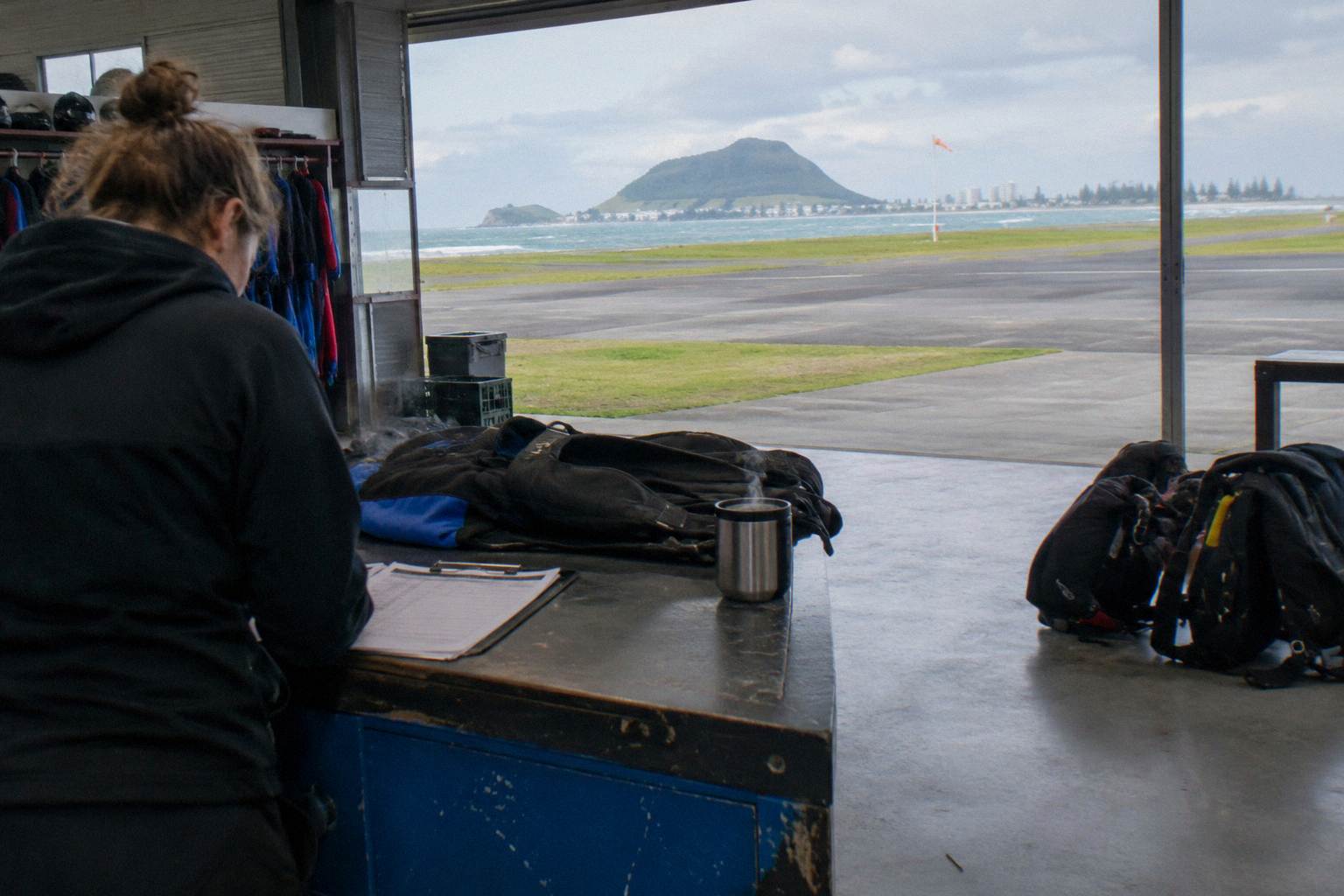
The operator's what-to-know page puts it plainly: allow around 1.5 hours for the whole experience, though on a quiet day it can be quicker, and the FAQ gives the range as 1h30 to 2h. The 30-minute early arrival is a stated requirement, not a suggestion, and it exists because a working airport runs on schedule. The operator notes that sometimes they can run a little late due to weather or traffic on the airport, which is the plain trade-off of jumping from a field shared with airline operations rather than a dedicated private strip.
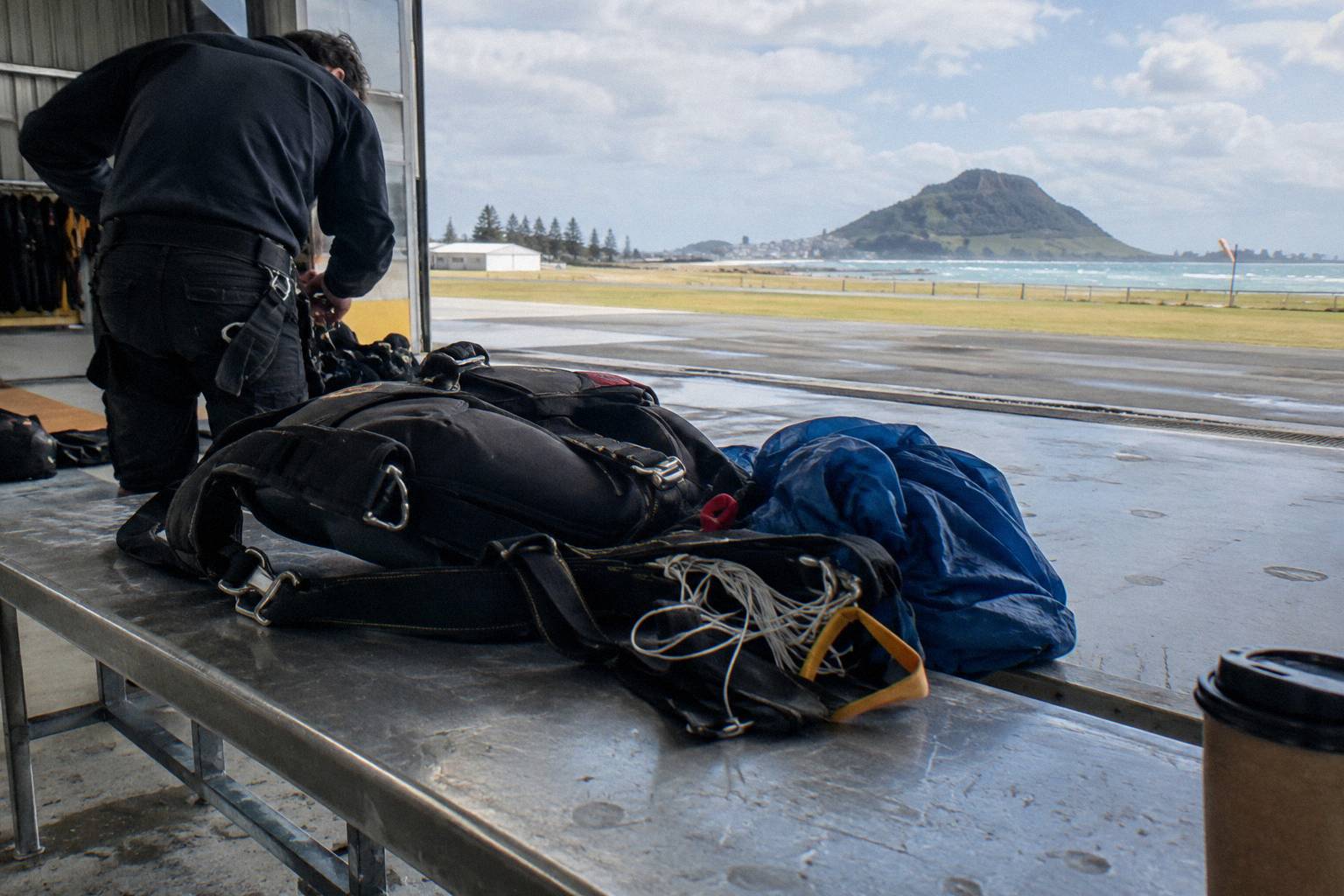
A practical arrival checklist looks like this, built from the operator's stated requirements:
| Before you leave | Why it matters |
|---|---|
| Closed shoes that cannot fall off | Mandatory for everyone, stated on the FAQ |
| Comfortable, weather-appropriate clothes | Jumpsuit optional in warm months, supplied in cold |
| Glasses or contacts if you wear them | Goggles are supplied that fit over glasses |
| Nothing loose in pockets | Passengers cannot carry their own camera in freefall |
| A light meal an hour or two before | An empty stomach invites lightheadedness |
| Your booking confirmation and ID | Check-in happens before gear-up |
| Time buffer for the 30-minute early arrival | Check-in, harness fit and briefing all happen first |
Weather also plays into the day. The operator says that if the weather does not look good, they will call you on the day of your jump and work something out to fit your schedule, which is worth knowing if you are planning a tight cruise-stop itinerary. The full picture on holds, reschedules and cancellation terms is in the skydive weather and cancellations explained guide, which separates the operator's direct-booking terms from the 24-hour free cancellation on the booking pages.
If you are still choosing between the two jump altitudes before you settle a time slot, the decision changes your time in the aircraft: the 12,000 ft option includes a 15-minute scenic flight and the 15,000 ft option a 20-minute climb, on top of the same ground routine. That comparison is worth a read before you pick a slot.
Where Does The Plane Take Off And Land?
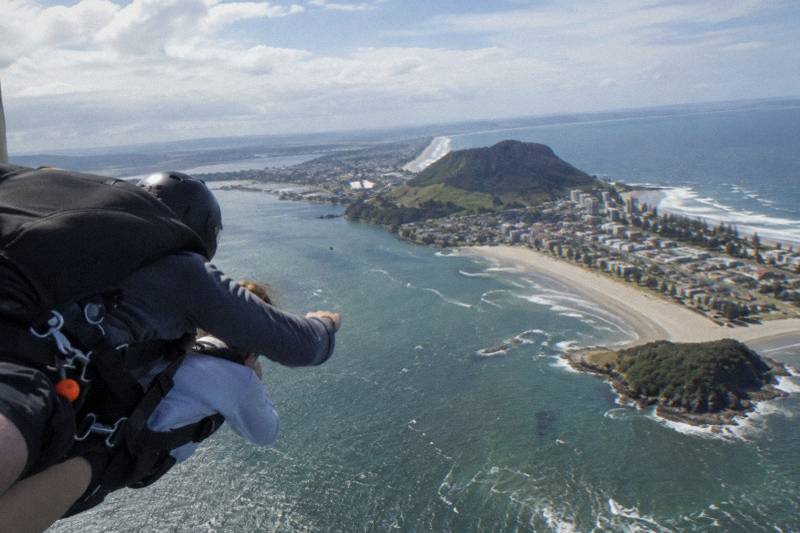
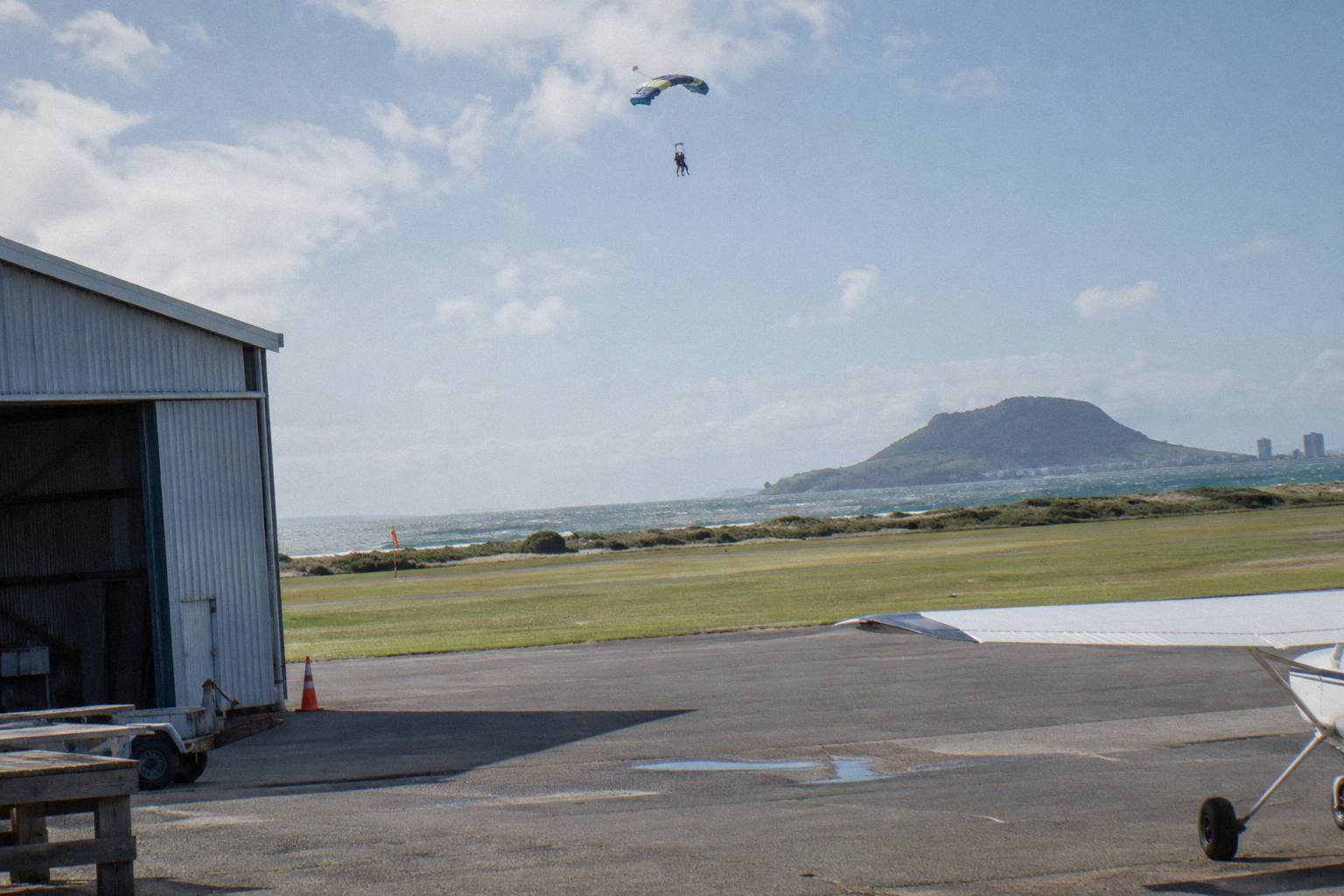
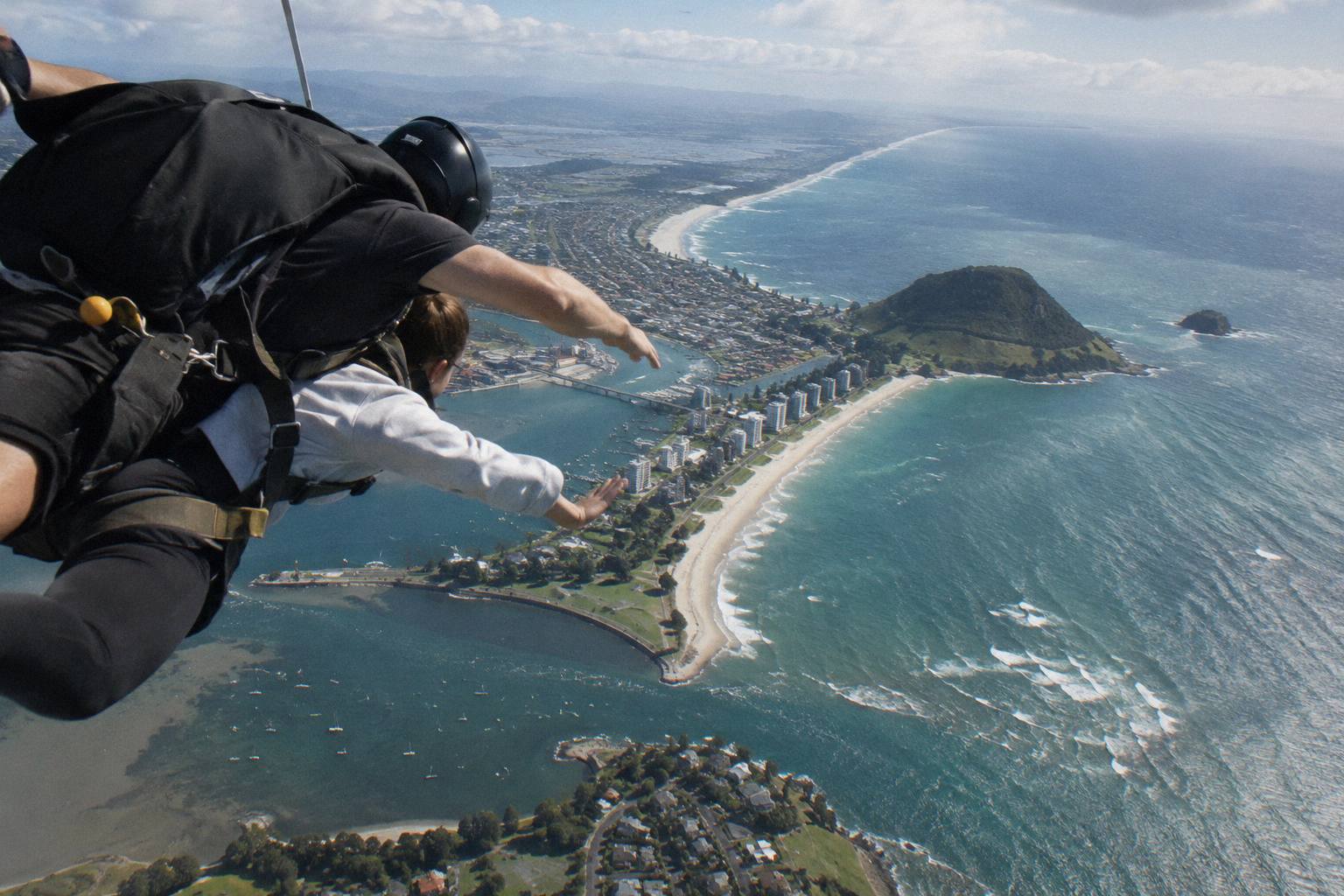
The aircraft takes off and lands at the same place, on the airfield at Tauranga Airport, and you finish the jump standing on airport grass rather than on sand. The operator describes a viewing area for spectators and says plainly that jumpers get in the plane and land in the same place. Mount Maunganui's beach is a view from altitude, never a landing zone, and the landing area itself is small because it shares the field with scheduled airline traffic.
This is one of the most common misconceptions about jumping in Tauranga, and it is worth settling before you brief your spectators. The operator's FAQ explains that the landing area is small and that there are plenty of rules with the airport so the skydive operation can co-exist with the airline traffic, and their landing pattern is built around that constraint. You will see the Mount, the harbour and Matakana Island from the air, but the parachute brings you back to the drop zone you left.
For spectators, the same-place takeoff and landing is good news. Friends and family can wait at the viewing area, watch the Cessna climb away with two tandems aboard, and then watch both canopies come back into the field, generally within the operator's stated few minutes of canopy ride after freefall. Nobody needs to drive anywhere or chase a landing point down the coast. The freefall time itself varies: the operator states that freefall times are an indication only and can change with weather conditions and body shape, a point worth passing on to anyone timing the day from the ground.
If you are deciding between jumping and simply flying, the same airport also hosts scenic flight options where nobody leaves the aircraft, a split worth considering for a nervous traveller or a mixed group. The featured jump for this route is From Tauranga: Skydive over Mount Maunganui, a 5.0-rated listing from 66 reviews that runs to 1.5 hours and offers both 12,000 and 15,000 ft options; Check availability once you know your date.
How Far Is The Airport From The Cruise Terminal?
The airport is a 5 to 10 minute drive from the cruise ship dock at Mount Maunganui, according to the operator's own FAQ, which makes a tandem jump one of the few adrenaline activities that genuinely fits a port call. The short transfer means the 1.5 to 2 hour on-site time, plus the 30-minute early arrival, still leaves room in a standard shore day. The risk is weather and the airfield schedule, not distance.
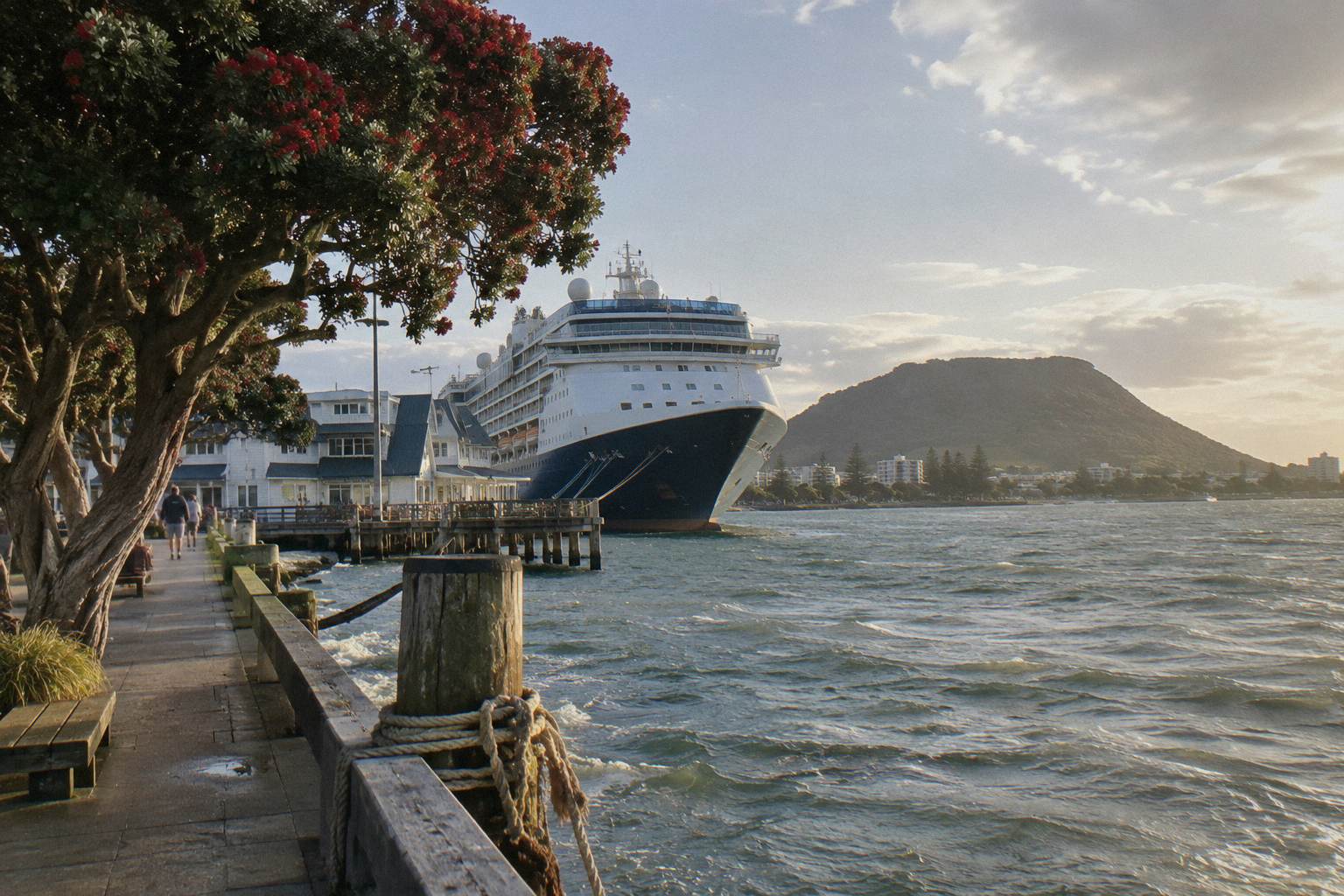
Tauranga's cruise season runs from October to April, and the port is one of the busiest regional cruise stops in the country. The arithmetic works like this: even allowing a generous 15 minutes to get off the ship and into a taxi or shuttle, you can be at the airport inside half an hour, and the full experience from arrival to landing fits inside a three-hour window with slack. The risk on a cruise stop is not the transfer, it is the weather and the airfield schedule, so the earlier slot you can take in the day, the more room there is to work something out if conditions turn. The operator's practice of phoning on the day when the forecast looks poor matters most to visitors whose ship sails at a fixed hour.
Cruise passengers should read the dedicated skydiving on a Tauranga cruise stop planning guide, which covers timing a jump against all-aboard times and what to do if the ship's schedule shifts. The core advice stands regardless: book the earliest slot that fits, arrive 30 minutes before it, and treat the 5 to 10 minute transfer as the easiest part of the day.

How Long Is The Drive From Auckland, Hamilton, Rotorua Or Taupo?
The drive from Auckland takes about 2 hours 30 to 40 minutes over 204 km, from Hamilton about 1 hour 25 minutes over roughly 105 km, from Rotorua about 50 minutes over roughly 57 km, and from Taupo about 1 hour 50 minutes to 2 hours over roughly 143 km. All four routes finish at the same place, the airport field on the Mount Maunganui side of the harbour.
| From | Distance | Typical drive time |
|---|---|---|
| Auckland | 204 km | 2 hours 30 to 40 minutes |
| Hamilton | About 105 km | About 1 hour 25 minutes |
| Rotorua | About 57 km | About 50 minutes |
| Taupo | About 143 km | 1 hour 50 minutes to 2 hours |
The Auckland figure deserves a caution. Two and a half hours is the clean run, and the approach into Tauranga crosses the Kaimai Range, whose highest point, Mount Te Aroha, reaches 953 metres according to the Wikipedia page for the Kaimai Range. Range crossings mean weather and slower traffic, so anyone driving up from Auckland for a booked slot should build in at least an extra half hour and treat the 30-minute early arrival as the floor, not the target. The same applies in reverse if you are driving on afterward.
Taupo deserves a special note, because it is the one city on this list with its own drop zone. If you are basing yourself in Taupo, you can jump over Lake Taupo, New Zealand's largest lake at 616 square kilometres per the Wikipedia page for Lake Taupo, with a local operator, or drive roughly two hours to jump over the Bay of Plenty coast. The trade-offs between the two locations, including the different age and weight rules that apply in Taupo, are set out in the Tauranga versus Taupo skydive comparison.
That comparison has real weight attached. The Tauranga rules are a minimum age of 7 and free booking under 110 kg, while the Taupo operator's own listings run different eligibility bands, so a family or a heavier jumper may find one location workable and the other not. Never assume the rules transfer between drop zones; they are set per operator. For Taupo-based travellers who want the lake views, the Lake Taupo 12,000-Foot Tandem Skydiving listing, rated 5.0 from 457 reviews and including hotel pickup, is the direct option.
Can Spectators Come, And Where Do They Wait?
Yes, spectators are welcome, and they wait in a designated viewing area at the same spot where the plane takes off and lands. Since the jump starts and ends on the airport field, friends and family stay in one place the entire time: they watch the Cessna leave, wait through the climb and freefall, and see the canopy descend back to the landing area. Plan for the same 1.5 to 2 hours, plus 30 minutes early arrival.
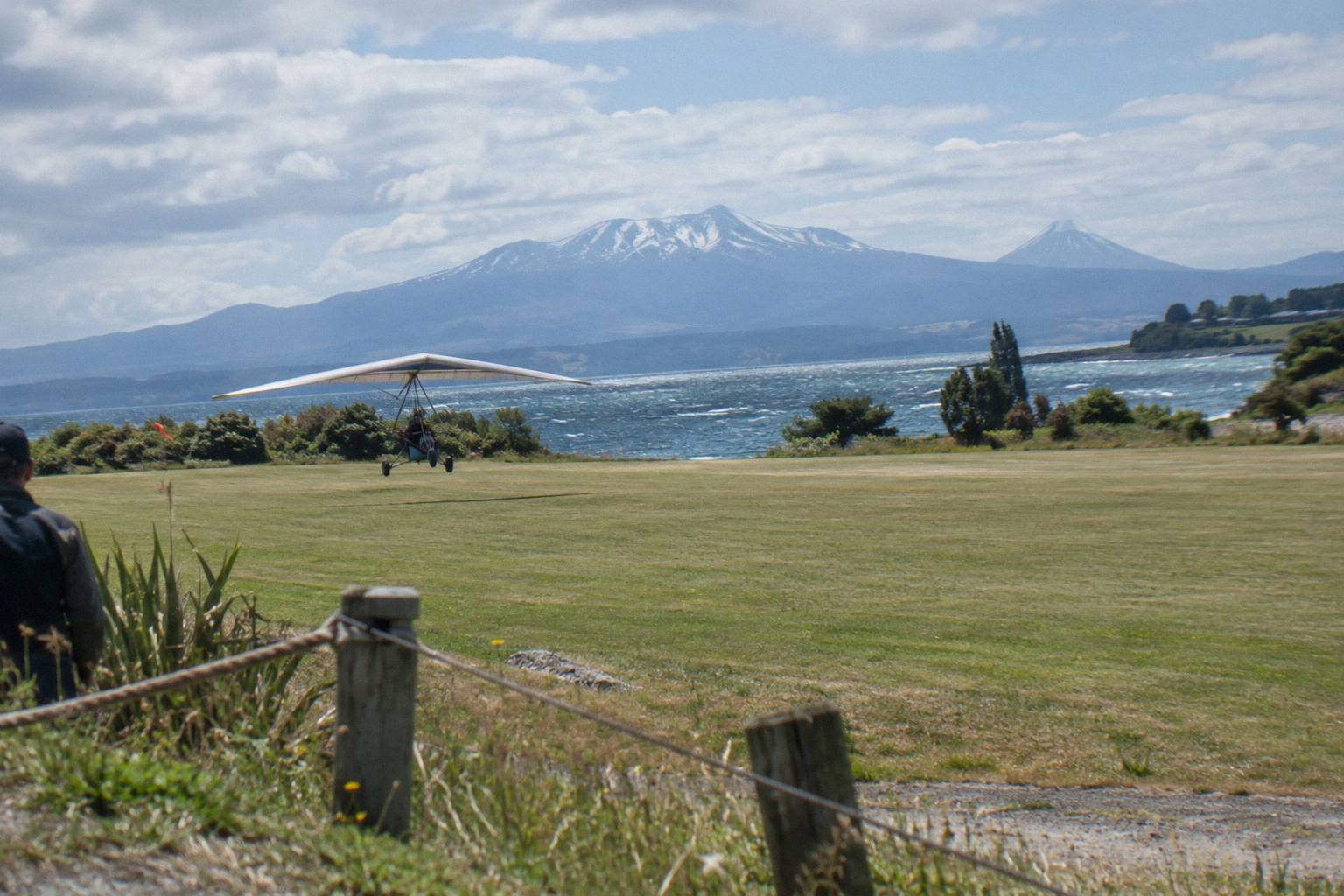
The viewing arrangement is one of the quiet advantages of an airport-based drop zone over a remote one. There is no chasing the aircraft by road, no guessing where the canopy will land, and no lost hour of the day for non-jumpers. The operator's what-to-know page confirms the setup: a viewing area for spectators, with the plane boarding and landing in the same place. Anyone waiting should expect the airfield environment that comes with it, open ground and airline traffic sharing the field, rather than a purpose-built visitor centre.
A few practical notes for the people on the ground. The same weather logic applies to them: if conditions are poor, the jump may shift, and the operator calls on the day to work something out. Spectators also get the best of both worlds on photography, since they can film the landing from outside the aircraft while the jumper cannot carry a camera in freefall, a restriction the operator states comes under New Zealand civil aviation law. What the jumper themselves can buy, from wrist-camera photo packages to a 360 video and an outside camera flyer, is worth researching before the day.
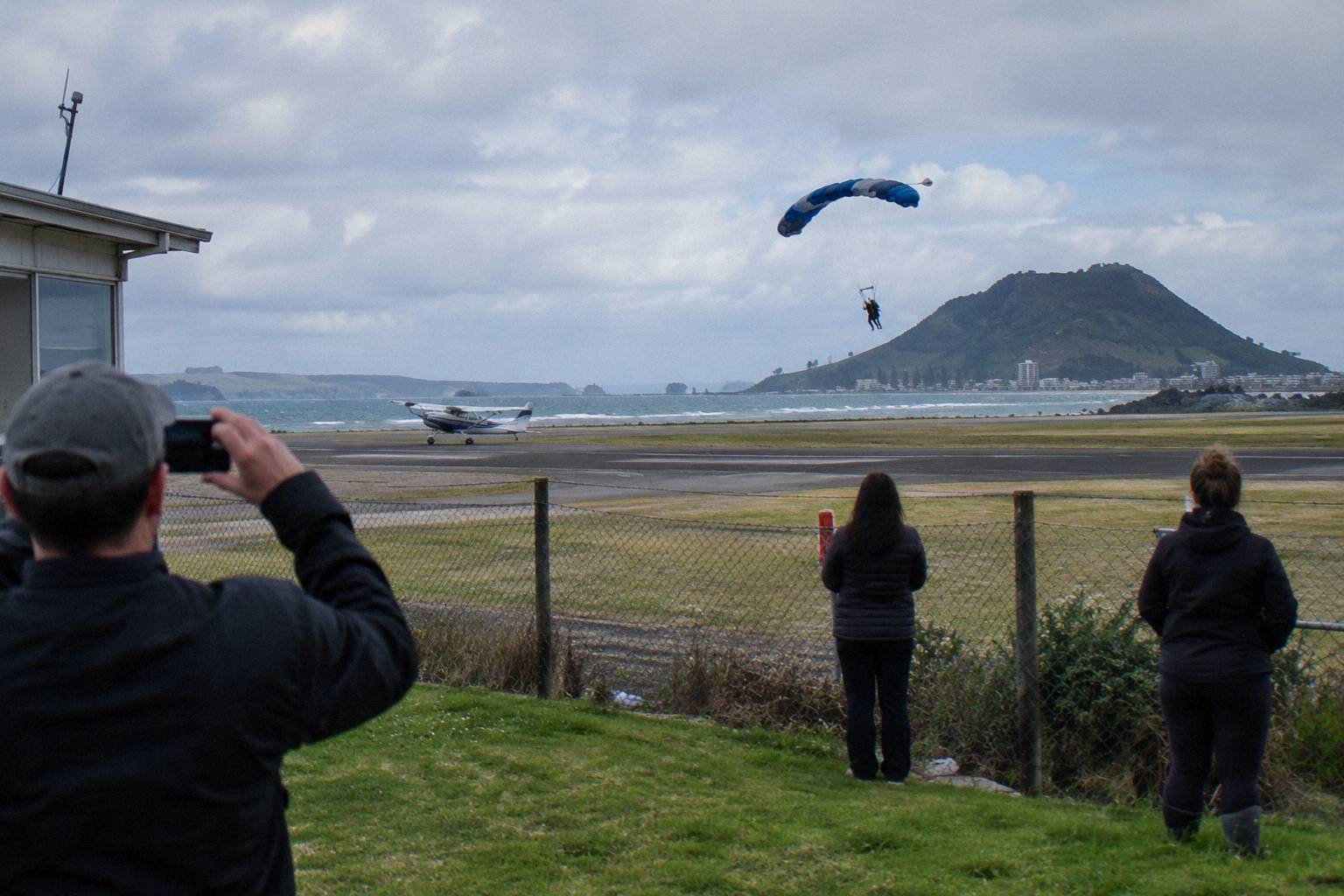
Couples and groups have an extra reason to like the single-site setup. With the aircraft taking two tandems at a time, a pair can effectively share a lift cycle, and the people not in that cycle watch from the fence line. The planning detail for that scenario, including how the two-at-a-time aircraft shapes a group day, is worth working through before you book for more than two people.
What Else Flies From The Same Airport?
Yes, several other operators fly from the same Mount Maunganui airport precinct, including fixed-wing scenic flights over the Mount and the Bay of Plenty coast, plus helicopter tours launching from hangars along the same airport roads. That means a mixed group can split up, with non-jumpers taking a genuine aviation experience while staying within a few hundred metres of each other. All of these are flights, not jumps, so nobody leaves the aircraft.
For a group where one person jumps and others would rather keep both feet in the plane, the Mount Maunganui Scenic Flight: Departing Tauranga Airport is a 30-minute fixed-wing option from the same operator family, taking in the coastline without a parachute involved. It runs to the same meeting point logic: you show up at the airport on the Mount side, at the time on your booking calendar.
Fixed-wing scenic flights run from the same airport precinct, ranging from a 30-minute Mount Maunganui circuit to a 1.5-hour Coromandel and Cathedral Cove trip and a 2-hour Mount Ruapehu flight, all operated by Skydive Tauranga. Helicopter options sit outside the airport roster: a Cathedral Cove coastal helicopter tour from Tauranga, plus a Taupo helicopter flight combined with a 15,000ft skydive. Weight rules for helicopter seats are set by the helicopter operators, not the skydive weight rules, so check each product's own terms.
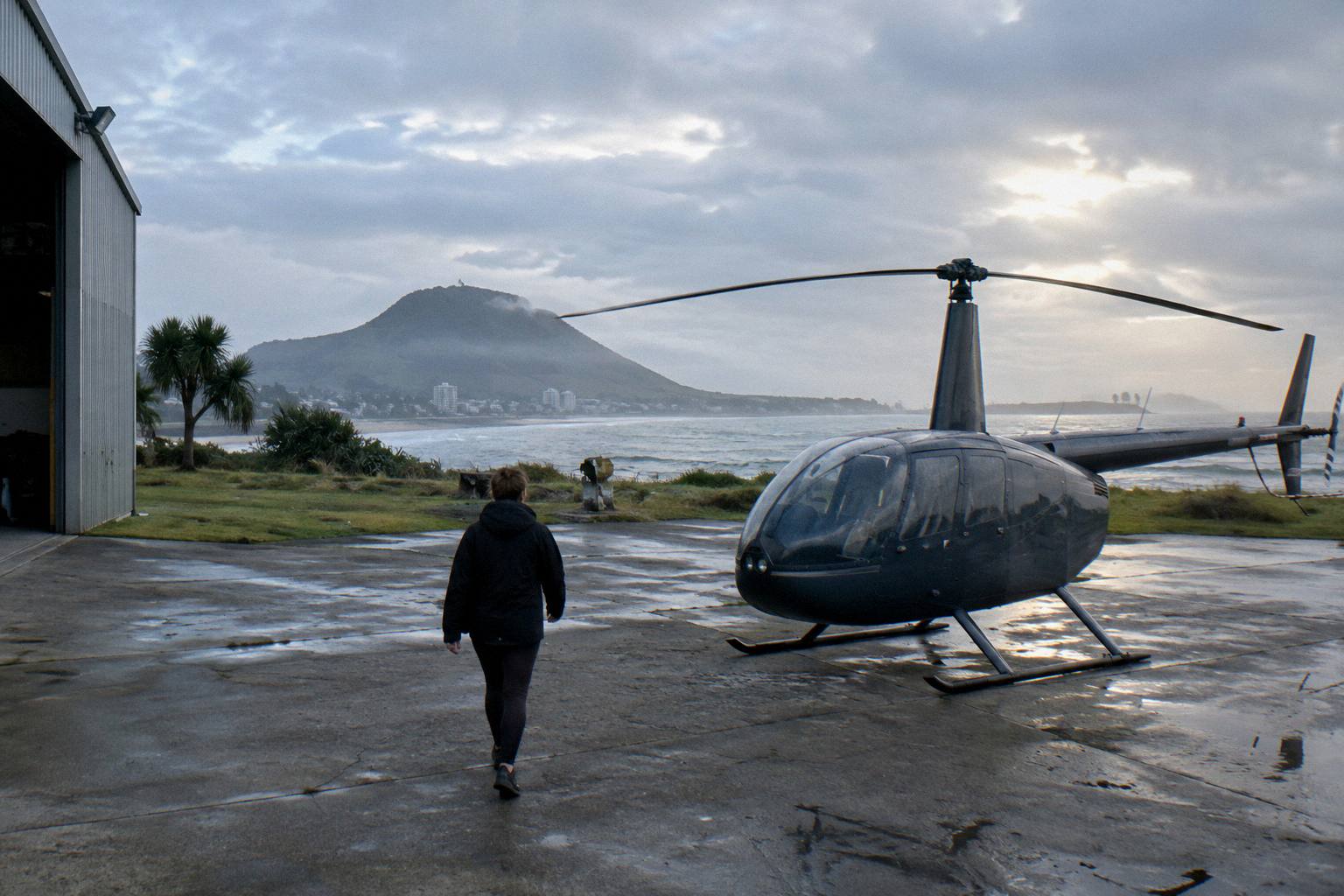
The broader decision between hanging out of a plane door and staying inside one comes down to what you want from the air: a skydive is about the freefall, a scenic flight is about sustained views, and the airport layout means a group can reasonably do both from the same base on the same morning. The essential visitor detail, that Tauranga Skydive and its neighbouring operators all work from the one field on the Mount side of the harbour, is what makes that combination possible at all.
What Trips People Up Before You Book
The mistakes are consistent: assuming the jump lands on the beach, arriving with minutes to spare instead of the required 30 early, treating the Auckland drive as a two-hour hop, and mixing up the weight and age rules between Tauranga and Taupo. People also book a late slot on a cruise day and leave no margin, or plan to carry their own camera without realising passengers cannot. Each is avoidable with one decision made at booking time.
The beach assumption is the most stubborn. The Mount Maunganui beach is a view from altitude, and the operator is explicit that the landing area is on the airport field, small, and shared with airline traffic under airport rules. Anyone picturing a sand landing, or briefing spectators to meet them on the sand, needs to reset to the viewing area at the drop zone.
Timing errors come next. The stated requirements are simple: arrive at least 30 minutes before scheduled takeoff and allow 1.5 to 2 hours on site, with freefall times an indication only and the day able to run late for weather or airport traffic. Booking the last afternoon slot on a fixed-departure day, whether a cruise sailing or a long drive home, removes every buffer the schedule gives you. The drive-time table above is the fix: build the day backwards from your slot, using the real distances, and add margin for the Kaimai crossing if you are coming from Auckland.
Finally, the rules do not transfer. The Tauranga operation sets its own minimum age of 7, requires a parent or guardian consent letter under 18, asks that children under 12 visit the dropzone first to be fitted in a harness, and books freely under 110 kg with a phone call above that, per the operator's FAQ. The Taupo operators publish different bands. Satisfy the rules for the specific listing you are booking, not the ones you read about for a different drop zone, and the meeting point will be the only surprise left on the day.
For anyone whose real question is the altitude choice rather than the logistics, the difference between the 12,000 and 15,000 ft options, and the total time each one adds to your day, is worth settling before you pick a slot on the booking calendar.
Common Questions About Getting To The Airport
Where Exactly Do I Meet For A Skydive In Tauranga?
The meeting point is Tauranga Airport, Mount Maunganui. The company behind the operation is registered at 2 Dakota Way, Mount Maunganui 3116, inside the same airport precinct. Once you are within the airport grounds on the Mount side of the harbour, the aviation hangars are close together and the operator's base is among them.
How Early Should I Arrive Before My Jump?
The operator asks you to arrive at least 30 minutes before your scheduled takeoff. That window covers check-in, meeting your instructor, harness fitting and the safety briefing. The whole experience on site runs between 1.5 and 2 hours, and can be quicker on a quiet day.
Do You Land At The Airport Or On The Beach?
You land back at the airport. The plane takes off and lands in the same place on the airfield, and there is a viewing area for spectators at that spot. Mount Maunganui's beach is a view from altitude, not a landing zone.
How Far Is The Drop Zone From The Cruise Ship Terminal?
The operator's FAQ describes the airport as a 5 to 10 minute drive from where the cruise ship docks. That short transfer is why a tandem jump fits comfortably inside a standard shore day, provided you book a slot with margin before your all-aboard time.
Can Friends And Family Watch The Jump?
Yes. The operator states there is a viewing area for spectators, and because the aircraft takes off and lands in the same place, spectators stay in one location for the entire experience. They should plan for the same 1.5 to 2 hours plus the early arrival.
Which Driving Times Should I Plan For To Reach The Airport?
Allow 2 hours 30 to 40 minutes from Auckland, about 1 hour 25 minutes from Hamilton, about 50 minutes from Rotorua, and 1 hour 50 minutes to 2 hours from Taupo, then add buffer for weather and the 30-minute early arrival requirement.