Photo And Video Packages For A Tandem Skydive At Tauranga Airport
Every camera option for a Tauranga tandem jump, what each package actually records, what it costs in New Zealand dollars, and the rules about bringing your own phone.
Short answer
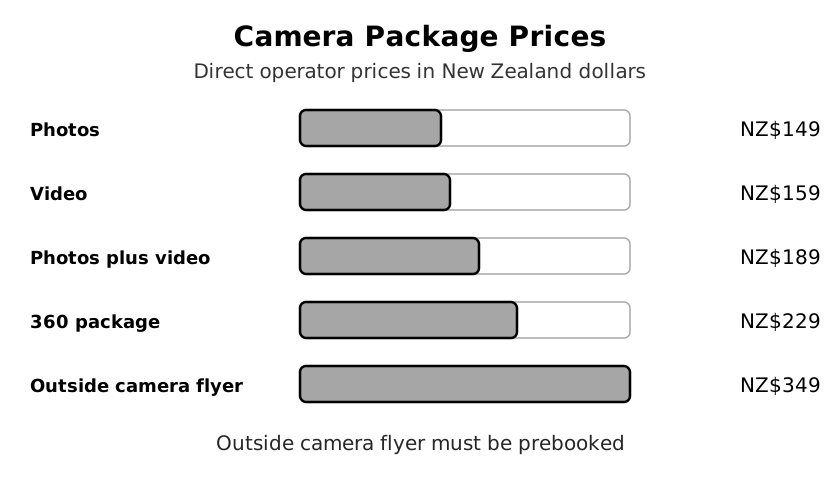
Skydive Tauranga sells four camera add-ons for a tandem jump: photos at NZ$149, video at NZ$159, photos plus video at NZ$189 on the instructor's wrist camera, a 360 package at NZ$229, and an outside camera flyer at NZ$349 which must be prebooked. Photos and video are never included in the jump itself, and passengers may not carry their own camera.
Skydiving is one of the few activities where the footage genuinely matters: the freefall lasts less than a minute, and a still photo is often the only way people back home believe it happened. If you are weighing up the options for a jump and want the background first, the guide to what happens on a Bay of Plenty tandem skydive walks through the whole experience from check-in to landing. The camera decision is a real part of the booking, with four packages at four different price points. This page lays out what each one records, what it costs, and the rules around filming, so you can settle the extras before you pay.
| Fact | Detail |
|---|---|
| Photos package | NZ$149, instructor's wrist camera |
| Video package | NZ$159, instructor's wrist camera |
| Photos plus video | NZ$189 on the wrist camera |
| 360 package | NZ$229, hand edited into a 3 to 4 minute video |
| Outside camera flyer | NZ$349, must be prebooked |
| Own camera or phone | Not permitted for tandem passengers |
| Footage delivery | Emailed link by the end of the day |
| Included in the jump? | No, camera packages are always extras |
What Photo And Video Packages Can You Buy?
There are four camera add-ons, and every one of them is filmed by the operator rather than by you: photos at NZ$149, video at NZ$159, photos plus video together at NZ$189, a 360 package at NZ$229, and an outside camera flyer at NZ$349. The basic three run off a camera attached to the instructor's wrist: photos only, video only, or both together. Above those sit the two premium options: the 360 package filmed on a camera the instructor carries, and the outside camera flyer, a second skydiver who jumps alongside you with a camera on the helmet. None of these are part of the jump price, and passengers are not allowed to carry their own phone or camera during the jump.
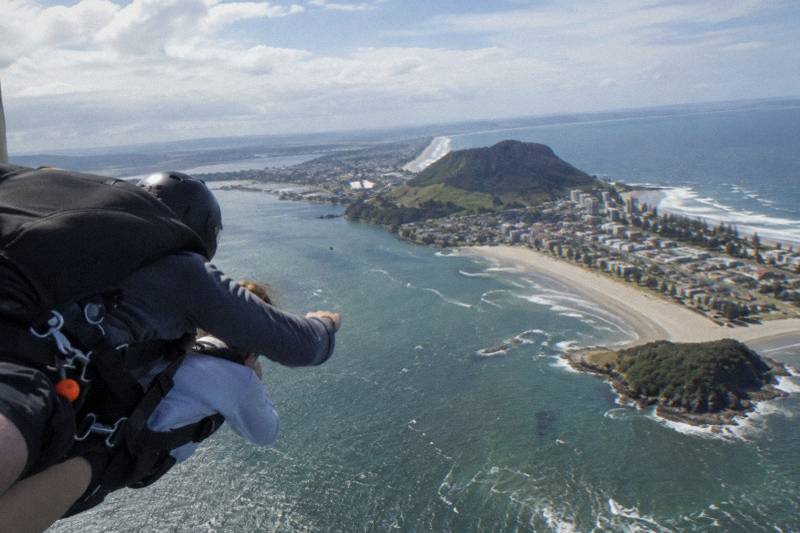
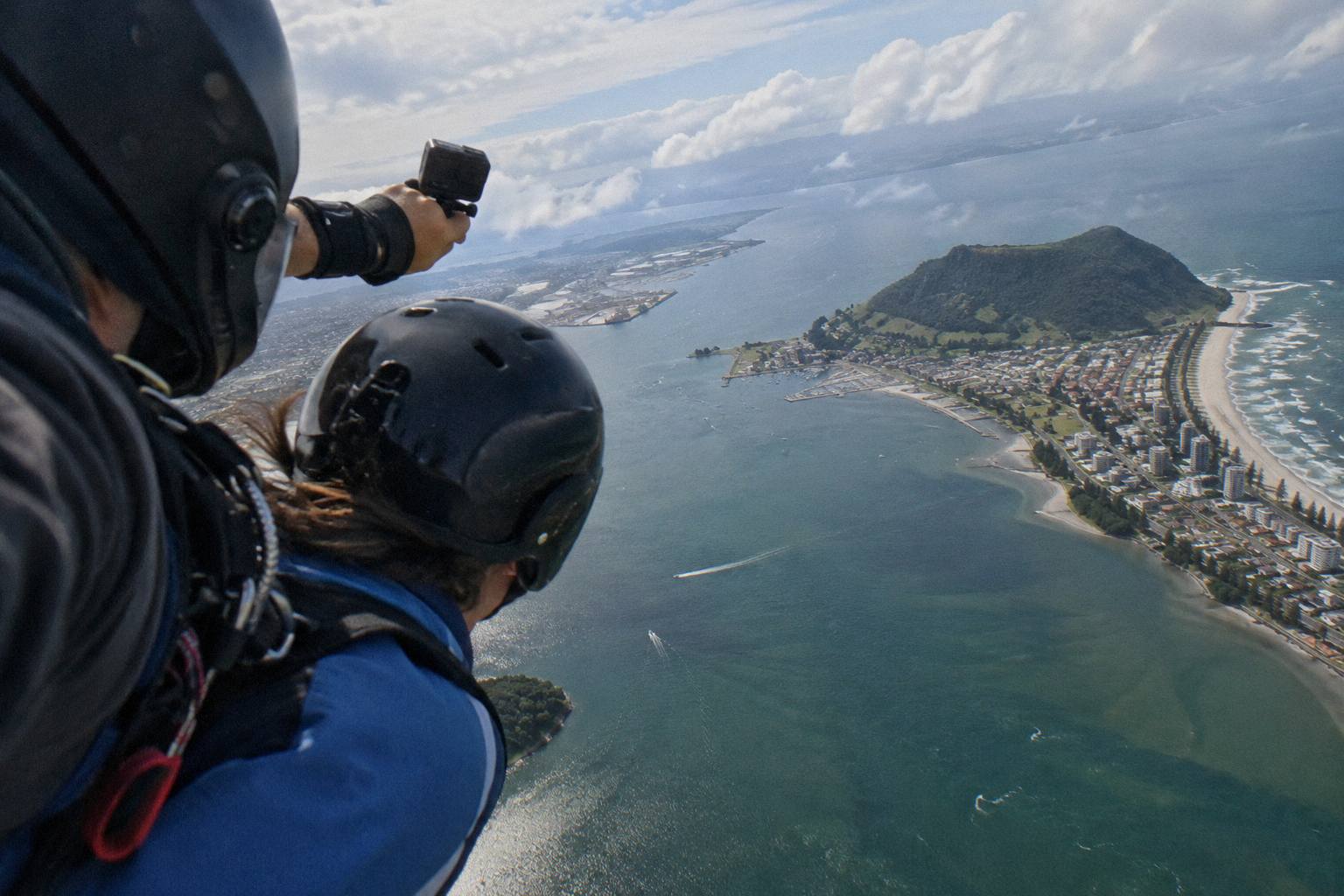
The wrist camera is the workhorse of tandem skydiving worldwide. The instructor has it strapped to a wrist, points it at you during freefall and under the parachute, and the same footage produces both the stills and the video. Because it sits a metre or so from your face, the framing is close: your expressions, the harness, the sky behind you. What it does not capture well is you as a small figure against the whole Bay of Plenty, because the camera is too near for that scale.
The 360 package is the widest option. The operator says the instructor has a 360 camera and films the whole experience, and that the best angles are hand edited into a video of three to four minutes. That editing step is the difference: someone has to cut a sphere of footage down to a watchable clip, which is why it sits above the wrist camera in price.
The outside camera flyer is a different product altogether. Another skydiver jumps with you with a camera mounted to their helmet, which means the footage can show you from a distance: your full body in the door, in freefall, and under canopy, with the coastline in frame. It is also the one package the operator says needs to be prebooked, because it depends on a second person being available and free on your slot. Decide that one early or it will not happen. Full detail on all four sits on the operator's camera packages page.
How Much Do The Camera Packages Cost?
The wrist camera options run NZ$149 for photos, NZ$159 for video, and NZ$189 for both, the 360 package is NZ$229, and the outside camera flyer is NZ$349, all in New Zealand dollars and all separate from the jump price. The jump itself is priced separately at NZ$449 for 12,000 ft and NZ$549 for 15,000 ft on the operator's own booking. Camera prices vary by date and group the same way jump prices do, and the booking page shows the price for the date you choose, so treat every figure here as the standard package price rather than a guarantee for a specific slot.
| Package | What it records | Price | Booking note |
|---|---|---|---|
| Photos | Still images from the instructor's wrist camera | NZ$149 | Addable when booking |
| Video | Video from the instructor's wrist camera | NZ$159 | Addable when booking |
| Photos + video | Both from the same wrist camera | NZ$189 | Addable when booking |
| 360 | Full experience on a 360 camera, edited to 3 to 4 minutes | NZ$229 | Addable when booking |
| Outside camera flyer | A second skydiver films you from beside you | NZ$349 | Must be prebooked |
Read the table as a ladder. The step from photos to both costs NZ$40 more than photos alone, which is less than the step from video to both, so "both" is the value point if you want any video at all. The jump from "both" to 360 is NZ$40 on top again, and buys the wider, edited film rather than a straight clip. The outside flyer more than doubles the basic package price, and buys a completely different kind of image: you, full frame, from outside.
One structural point worth getting straight early: the jump listings themselves include no photo or video. Whether you book the 15,000ft Tandem Skydive in Tauranga, the Bay of Plenty 15,000ft Skydive, or the Skydive Over Mount Maunganui listing, the camera package is a separate line. Budget for the jump and the footage as two decisions, not one. The operator's what-to-know page also notes that the outside camera package needs prebooking, so that one is a decision to make before the day, not at the hangar.
If you are still choosing which jump to attach a camera package to, the height matters for the footage as much as the ride. The Skydive Over Mount Maunganui listing runs at 12,000 or 15,000 ft by option, with freefall of 30 to 45 seconds at the lower height or about a minute at the higher one, and it carries a 5.0 rating from 66 reviews. The longer the freefall, the more usable footage every package produces, because the camera-carrying part of the jump is mostly the freefall and the few minutes under canopy.
Which Package Suits Which Jumper?
Most jumpers should buy the combined photo and video package at NZ$189, since it captures the full experience at a lower price than buying either option separately and leaves you with shareable footage of the jump. Reserve the outside flyer package at NZ$349 for a milestone jump, such as a birthday or a farewell skydive, where the extra camera angle matters. The combined wrist package costs only NZ$40 more than photos alone and covers both formats, which is what most people want from a once-only jump. The outside flyer suits a birthday, a proposal, or a farewell jump where the wider shot matters more than the money. Solo photos at NZ$149 suit someone who only ever shares stills and never watches video, which is a real category of person, just a smaller one than most groups assume.
The decision is easier if you think about who will watch it. Photos go straight into messages and frames, and stills from a wrist camera are usually sharp because the camera is close. Video is what carries the story: the climb, the door, the freefall, the canopy ride. If your audience is family who will watch once and grandparents who will watch ten times, the NZ$189 package does both jobs without a second thought.
The 360 package earns its price for one specific reason: rewatching. A fixed camera films what the operator chose; a 360 film lets you look somewhere new each time, including back at the aircraft and down at the parachute. The trade-off is that the delivered file is an edit of three to four minutes, not the raw sphere, so you get the operator's cut of the best angles.
| If you want... | Buy | Why |
|---|---|---|
| Something to frame or post | Photos, NZ$149 | Close, sharp stills from the wrist camera |
| The story of the whole jump | Photos + video, NZ$189 | Both formats from one camera, best value step |
| A film worth rewatching | 360, NZ$229 | Hand edited, wider angles, three to four minutes |
| Full-frame shots of you jumping | Outside camera flyer, NZ$349 | A second skydiver films you from beside you |
There is also a group angle. The aircraft is a Cessna 182 that takes two tandems at a time, so a pair jumping together shares the climb but not the frame: each passenger's wrist footage is their own. If two of you are jumping and only one of you wants footage, that works cleanly, and you can read more in the guide to skydiving in Tauranga as a couple or group. For weight and age questions that affect who can jump at all, the weight limit guide covers the 110 kg booking threshold and the 30 kg minimum.
The related jump most people pair with a camera decision is the Skydive Over Mount Maunganui listing, which offers both heights and the 20 to 25 minute scenic flight that gives every camera package its backdrop. You can also check availability for your dates and add the camera choice once the slot is confirmed.
Can You Bring Your Own Camera Or Phone?
No, you cannot bring your own camera or phone on a tandem skydive in New Zealand. Civil aviation rules prohibit tandem passengers from carrying any device during the jump, so if you want footage of yourself in the air, the operator's camera packages are the only option available to you. This is a regulation rather than an operator preference, and it is printed on the operator's booking form. Loose objects in freefall are a hazard to you, your instructor and the aircraft, and a phone at 200 km/h of relative wind does not stay in a pocket. There is no negotiation, no exception for a small camera, and no workaround on the day.
The practical consequence is that everything on your social feed from a tandem jump was filmed by somebody whose job it is to film it. That is the whole reason the wrist camera, the 360 rig and the outside flyer exist as products. If you have seen helmet-mounted self-filmed tandem clips from elsewhere, those predate or sidestep rules that apply here; on this drop zone, the answer is a flat no. The full index of guides sits on Tauranga Skydive.
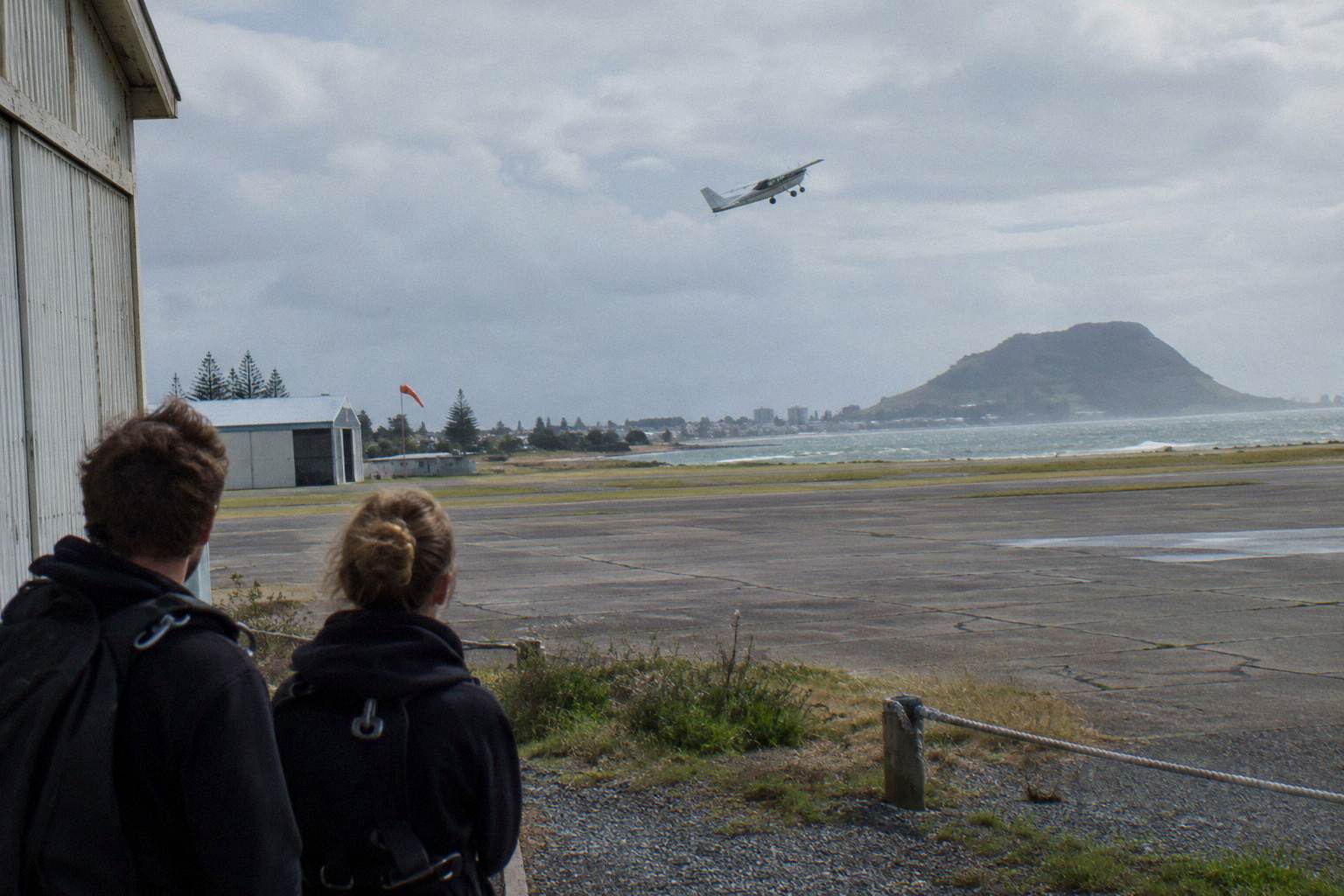
Spectators are different. There is a viewing area at the airport, and the aircraft takes off and lands in the same place, so people on the ground can film the plane, the climb away, and the landing from outside the fence. Friends and family with cameras are welcome there; only the jumper is restricted. The full wording on personal cameras sits on the operator's FAQ page.
If flying rather than filming is your interest, the same operator runs a two-hour Ruapehu scenic flight that climbs to 10,000 ft toward the mountain, and a comparison of a Tauranga skydive versus a scenic flight covers which suits a nervous flyer.
How And When Do You Get The Footage?
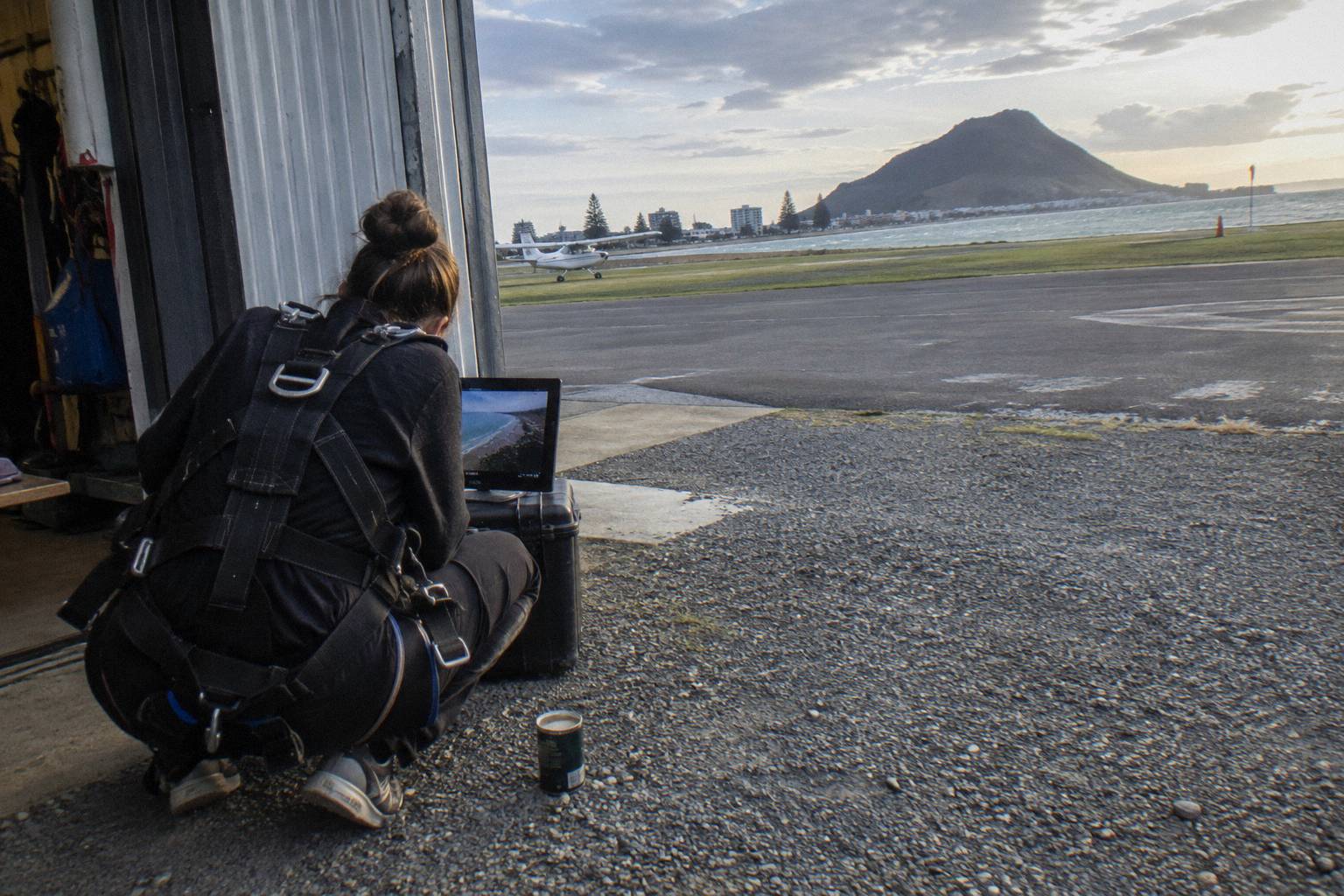
You receive your footage by email: if you booked a camera package, a download link is sent to you no later than the end of the day of your jump, and in most cases it arrives while your day is still going, so you can review and share the clips that same evening without waiting any longer than the promised deadline. The operator's what-to-know page states the delivery plainly, so you do not need to chase it on site. The emailed link arrives without any extra step on your part, which matters if you are jumping on a cruise stop or flying out the same evening: download the files before you lose wifi, because the link is your copy and you should keep a local backup of anything you care about.
The gap between jump and delivery is also why the outside flyer package must be prebooked. A second camera-carrying skydiver has to be rostered, briefed and in the aircraft plan, and that cannot be assembled on the morning while you are being fitted into a harness. If the outside shot is the one you want, book it days ahead, not at the check-in desk.
Timing around the jump itself is worth a sentence too. The operator asks you to arrive at least 30 minutes before your scheduled takeoff, and the whole experience takes between 1.5 and 2 hours. The camera work happens inside that window: ground shots at fitting, freefall, and the canopy ride, then the edit after landing. Cruise passengers can fit all of this into a port call, and the cruise stop skydive guide covers the timing logic, with the airport a five to ten minute drive from the cruise dock.
Do The Jump Listings Include Photos Or Video?
No. Across every Tauranga tandem skydive listing reviewed, photos and video are sold strictly as paid add-ons rather than being bundled into the jump price itself. That means the camera package always appears as a separate, optional line item at checkout, so if you want a visual record of your jump, you must select and pay for that package when booking. The 15,000ft Tandem Skydive in Tauranga, the Bay of Plenty 15,000ft Skydive, and the Skydive Over Mount Maunganui listing all carry the same structure: you pay for the jump, and camera packages are added on top at the prices above. Each of those bookings carries free cancellation up to 24 hours before the start for a full refund, so adding a package early costs you nothing if plans change.
| Listing | Camera included? | Free cancellation |
|---|---|---|
| Skydive Over Mount Maunganui | No, paid extras | Up to 24 hours before start |
| 15,000ft Tandem Skydive in Tauranga | No, paid extras | Up to 24 hours before start |
| Bay of Plenty 15,000ft Skydive | No, paid extras | Up to 24 hours before start |
That consistency makes the comparison simpler than it looks. All three listings meet at Tauranga Airport, Mount Maunganui, take off and land in the same place, run about 1.5 hours, and carry the same age 7 minimum and 110 kg booking threshold. The differences are the framing of the listing and, for the Maunganui option, the choice between 12,000 and 15,000 ft within one product.
The one roster exception to the no-included-footage pattern sits in Taupo, not Tauranga: the Taupo helicopter plus 15,000 ft skydive listing states that photos and videos are included, as a per-product detail. It does not transfer to the Tauranga listings, and the Tauranga versus Taupo skydive comparison covers the fuller trade-off between the two drop zones, including the roughly two hour drive between them.
The 15,000ft Tandem Skydive in Tauranga is the natural pairing for a camera package, because the about-a-minute freefall at 15,000 ft is the longest window any camera has to work with. See dates on the Tauranga 15,000 ft listing and settle the camera line at the same time.
What Trips People Up Before You Book
The four recurring mistakes are assuming your photo and video footage is included in the base price, arriving at the dropzone with no working phone plan for check-in and coordination, leaving the decision about bringing an outside flyer until too late in the booking process, and skipping the pre-jump checklist covering what to eat, what footwear to wear, and what paperwork to bring. None of these are expensive lessons in money terms, but two of them are unrecoverable: there is no second take of the freefall, and the outside camera flyer cannot be conjured on the day. Each is avoidable with one decision made before you travel, and none of them takes more than a few minutes of planning to settle properly.
First, the inclusion assumption. People book a jump, see an operator page full of video, and expect a file in their inbox. The jump listings include no photo or video anywhere on this drop zone; the packages are separate lines priced from NZ$149 to NZ$349. Decide before you pay so the budget is real.
Second, the phone plan. You cannot carry your own phone or camera on the jump under New Zealand civil aviation rules, so the plan of "I'll film it myself on my action cam" fails at the hangar. Hand the phone to a spectator, point them at the viewing area, and book one of the operator's packages for the in-air footage.
Third, the late outside flyer decision. It must be prebooked. If the full-frame third-person shot is what you actually want, that is a booking-day decision, not a jump-day one.
Fourth, the small stuff that stops a jump entirely: closed shoes are mandatory, you should eat a normal light meal rather than arrive empty, and anyone with a medical condition to declare should read the fitness and health checks guide beforehand. Weather can also move a slot, and the weather and cancellations guide explains how a weather call is handled on the day.
The Bay of Plenty 15,000ft Skydive carries the same 15,000 ft altitude and about-a-minute freefall window, and pairs with any of the same camera lines if the dates work out better on that listing.
Common Questions About Camera Packages
What Photo And Video Packages Can You Buy For A Tauranga Skydive?
Four: photos at NZ$149, video at NZ$159, photos plus video together at NZ$189, all off the instructor's wrist camera; a 360 package at NZ$229; and an outside camera flyer at NZ$349, which must be prebooked.
Are Photos Or Video Included In The Jump Price?
No. Across the Tauranga tandem listings, camera packages are paid extras. The jump and the footage are two separate lines at booking.
Can You Bring Your Own GoPro Or Phone On The Jump?
No. Under New Zealand civil aviation rules, no tandem passenger may carry a phone or camera during the jump. Spectators can film from the ground viewing area.
When Do You Receive The Footage?
If you took a camera package, you receive an email with a download link at the latest by the end of the day of your jump.
Which Camera Package Is Worth It?
For most jumpers, photos plus video at NZ$189: it costs NZ$40 more than photos alone and covers both formats. Choose the outside camera flyer at NZ$349 for a milestone jump where the full-frame shot matters.
Does The 360 Package Give You The Raw Footage?
No. The operator hand edits the best angles into a video of three to four minutes, which is what the emailed link delivers.